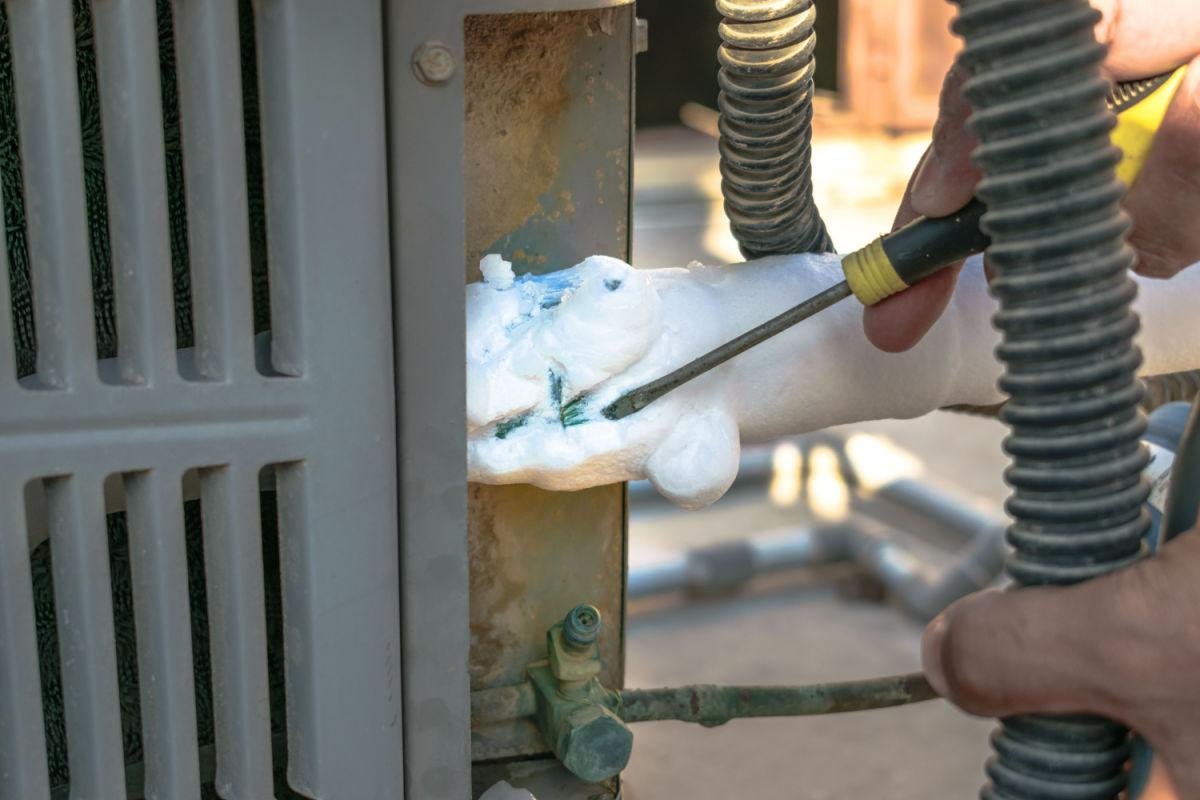
Why Your AC Keeps Freezing Houston Homes Every Summer
You pull the panel off your air handler expecting to find nothing wrong, and instead you find the evaporator coil wrapped in ice like a bad science experiment. This is one of the most common calls 75 Degree AC gets between May and August. If your AC keeps freezing Houston-style, on repeat, every few days, this is exactly why, and exactly where the line sits between something you can check yourself and something that needs a licensed tech. A homeowner turns the system off, lets it thaw, turns it back on, and it runs fine for a few hours before freezing again. By the third cycle, the compressor has started swallowing liquid refrigerant it was never built to handle, and a $250 service call is quietly turning into a $3,500 repair. What’s Actually Happening When Your AC Freezes Up An air conditioner doesn’t make cold air out of nothing. It moves heat. Refrigerant flows into the indoor evaporator coil, drops in pressure, and boils into a gas, and that phase change is what pulls heat out of the air your blower pushes across it. Under normal conditions the coil sits around 40°F. Two things have to stay balanced for that number to hold: enough warm air moving across the coil, and the correct volume of refrigerant inside it. When either one slips, even slightly, coil temperature falls below 32°F. Houston’s humidity means there’s always moisture sitting on that cold metal, and instead of dripping into the condensate pan, it freezes on contact. Give it twenty minutes and you’ve got a thin frost layer. Give it two hours and the coil is a solid block, and your blower is now pushing air against a wall of ice instead of through it. Here’s the part most homeowners miss: the ice isn’t the damage. The damage happens after. Liquid refrigerant that should have boiled off in the coil slips through unchanged and heads straight for the outdoor compressor, which is built to compress gas, not liquid. That’s called slugging, and it bends valve plates, shears motor windings, and cracks discharge reeds. A compressor that’s absorbed two or three freeze-thaw cycles rarely comes back to full life. Run it through a week of that and you’re compressor shopping. Why AC Freezing Up Is So Common Here Specifically Ask a tech in Phoenix why AC freezing up happens and you’ll get a shorter list than you’d get AC keeps freezing Houston. Three things stack up against us specifically. The humidity load. Houston sits above 70% relative humidity for most of May through October. A 3-ton system might be pulling 18 pints of water out of the air per hour on a wet June afternoon, and dehumidifying that air is more than half the system’s actual workload. Anything that disrupts drainage or airflow, even a dirty filter, freezes that moisture before it ever reaches the drain pan. Attic-mounted equipment. Around 95% of Houston homes run the air handler out of the attic, where summer temperatures regularly climb past 130°F. That heat dries out duct mastic and warps flex duct over time, which means air leaks out of the supply plenum before it ever reaches the coil. We’ve measured static pressure in older Memorial-area systems running nearly double the manufacturer spec, and that kind of restriction is exactly what tips a marginal system into a freeze. Grid-related airflow dips. During peak summer demand hours, typically 4 to 8 PM in July and August, brief voltage sags can cause a blower’s ECM motor to under speed. Less air across the coil while the compressor keeps calling for cooling pushes coil temperature down fast, and we’ve traced overnight freeze-ups in Cypress and Katy homes back to exactly this. Layer any of those on top of a refrigerant charge that’s already 8-10% low from a leak nobody’s noticed, and the freeze is basically scheduled. It’s why a system that would freeze in August in Dallas freezes in late May here. The Real Causes Behind an AC Keeps Freezing Houston Pattern After years of frozen-coil tickets across the metro, the causes break down fairly predictably. A dirty filter or filthy coil (the biggest one, by far) This is the only cause a homeowner can sometimes catch without a tech. A filter that’s been sitting for six months in a pet household turns into a solid wall, and less air across the coil means a colder coil. In homes with two cats, a 1-inch filter needs changing every 60-75 days, not twice a year. Beyond the filter, a coil that hasn’t been cleaned in years grows a film of dust that chokes airflow from the other side. Low refrigerant from a slow leak Refrigerant doesn’t wear out or evaporate on its own. If a system is low, it’s leaking, usually from a corroded Schrader valve at the service port, pinhole corrosion inside the coil itself, or a crack where the line set enters the attic. A 3-ton system that’s just 12 ounces low on a 6-pound charge will start freezing once runtimes stretch into May. Recharging without finding the leak first just delays the same call by a few weeks, this is the exact diagnostic gap our AC leak repair process is built to close. A failing blower motor A worn ECM module, a tired PSC motor bearing, or a blower wheel caked in dust all reduce the CFM crossing the coil. Homes with original 2008-2010 era blower motors are especially prone to this, since these motors lose efficiency gradually for a couple of summers before they fail outright. Blocked or closed ducts A damper someone closed and forgot about, a box stacked against a return grille, pet hair sealing off a return that hasn’t been vacuumed in two years. We always check the return path before touching refrigerant, because a full recharge on a duct-restricted system just freezes again in a week. Thermostat habits Setting the thermostat 8°F below room temperature on a humid afternoon forces runtimes past 90 minutes