
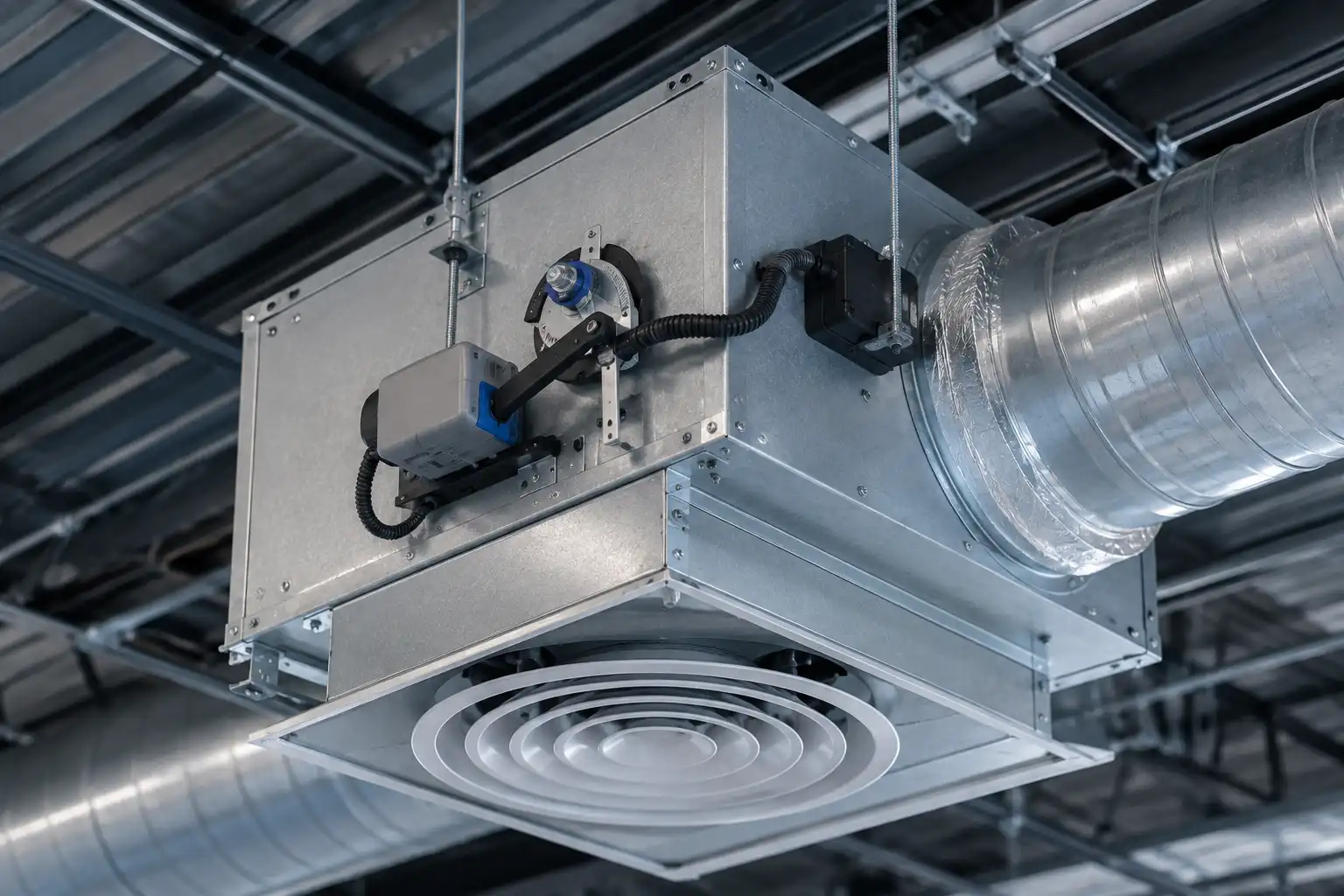
If you are not familiar with the question what is a VAV in HVAC, then it’s time to acquaint yourself with a key technology that significantly influences how we heat and cool commercial and large residential buildings. VAV means Variable Air Volume. VAV systems, in contrast to constant air volume systems, can vary the amount of airflow to a building depending on the heating and cooling needs of different areas within the building and the heating or cooling load.
You will find VAV units in big buildings like office buildings, schools, hospitals, shopping malls, hotels, etc. They can help to improve indoor comfort and reduce energy consumption if well designed and controlled.
VAV Meaning in Air Conditioning

VAV in air conditioning is mostly about energy-efficient temperature control. Rather than a constant airflow, the system adjusts the flow according to the need.
For instance, if the room gets filled up, the temperature in the room will go up, and more cooling will be needed. The VAV box can let more air flow. When the room is empty, airflow can be reduced.
VAV systems may thus allow better zone-level control since they can be more finely regulated on a per-zone basis. They are particularly well adapted to the problem of rooms differing widely in occupancy and heating and cooling requirements in building applications.
Read more What does SEER mean in HVAC
What Is Variable Air Volume in HVAC?
What does VAV mean in HVAC? Variable air volume is the term used when the amount of conditioned air delivered to a space is varied while keeping the space at the desired temperature and indoor environmental quality conditions.
A typical VAV system utilizes a variable-speed fan or the equivalent to meet changing demand. As individual VAV boxes decrease flow, the central system can also decrease fan speed when the controls are so designed.
This may save energy, because the fans don’t always have to run at full speed.
But VAV systems are a bit more involved than standard HVAC configurations. They must be properly designed, controlled, balanced, and maintained to perform efficiently.
Read more Houston Humidity: How It Damages HVAC Systems and What to Do About It
Main Components of a VAV HVAC System
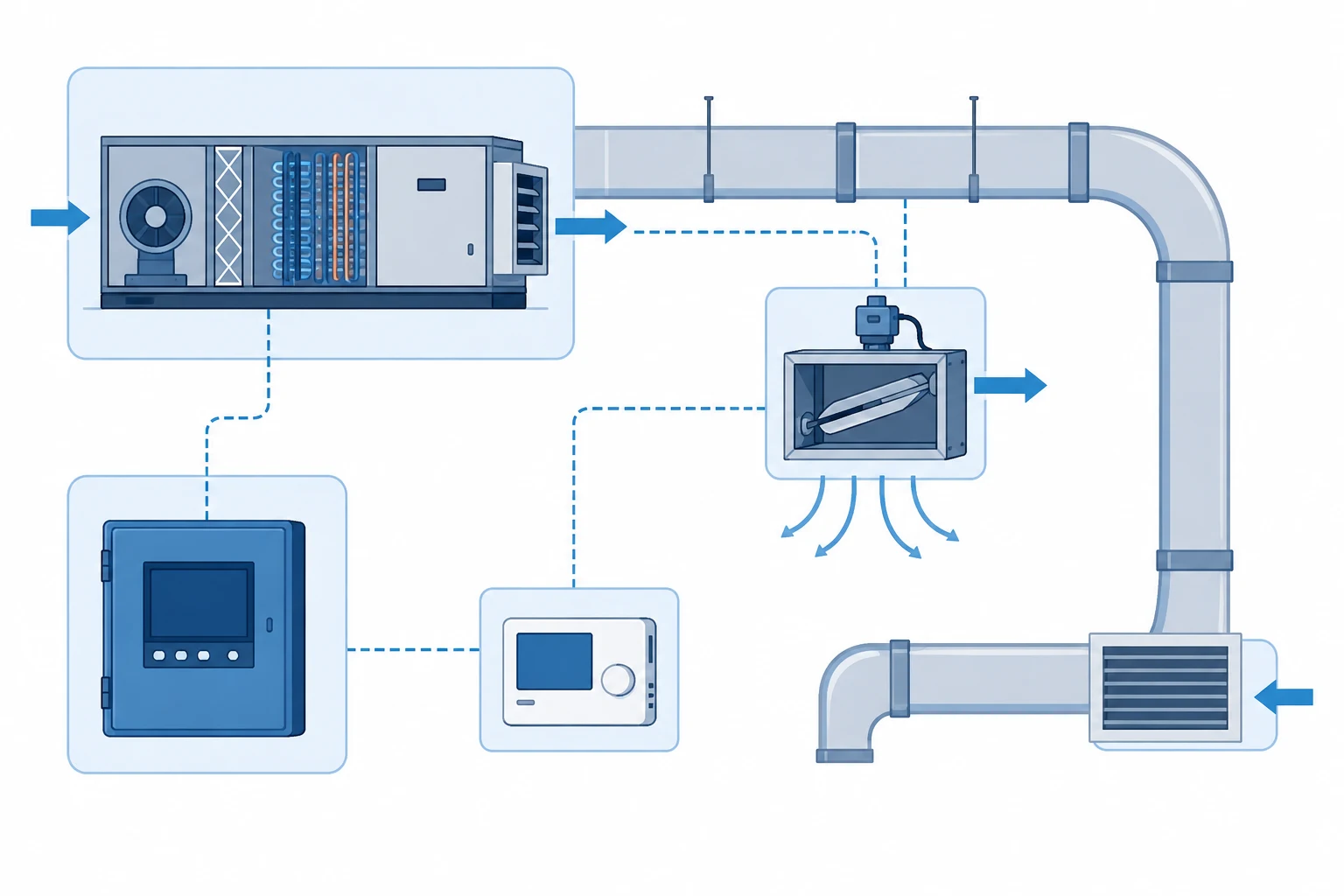
A VAV system includes a number of key components.
Air Handling Unit
The air-handling unit (AHU) pre-treats the air prior to distribution through the building duct system. It can cool, heat, filter, and move air, depending on the unit.
VAV Terminal Unit
VAV terminal (VAV box) is used to supply airflow to individual zones. It typically contains a motorized damper, which is regulated by a thermostat or building management system.
Damper
The quantity of air flowing through the VAV terminal is regulated by the damper. It may open more as the cooling load increases and close partially as the load decreases.
Thermostat or Temperature Sensor
The occupied space temperature is measured by the thermostat. The control system applies this information to decide when to increase or decrease the airflow.
Ductwork
Run conditioned air through ducts from the air handler to your living spaces. A good system design and well-sealed ductwork are the key to obtaining excellent performance.
Control System
Today’s VAV systems may employ complex digital control and building automation systems. Climate control, temperature, fan speed, and other operating conditions are coordinated by these controllers.
How Does a VAV System Work?

Operation of a VAV is fairly simple.
The central air-handling unit produces conditioned air first. This air moves into the supply plenum and from there enters the supply ductwork to various zones in the building.
A VAV terminal controls the amount of air that flows into a zone or space. A thermostat collects information on room temperature and sends it to the VAV controller.
When the controller detects that the room temperature is higher than the set point, it may open the damper to increase the airflow. The controlled environment becomes cooler as more cool air gets into the chamber again in the direction of the setup.
The damper can restrict the airflow once the desired temperature is reached in the room. In a balanced system, the central fan can also ramp down as the total airflow demand decreases in the system.
Thus, is this a continuous process throughout the building? Read the How to Prepare Your HVAC System for Houston-Area Heatwaves Step-by-Step
Benefits of VAV Systems
VAV systems have many benefits, especially in large building applications.
More Accurate Temperature Control
Due to the fact that the airflows can be individually controlled for each area, a VAV system is capable of delivering a higher level of temperature accuracy.
Energy-Saving Performance
There are significant energy-efficiency advantages. Airflow is reduced with diminishing cooling load. Variable-speed fans are also able to run at a lower speed instead of making full power all the time 100% of the time, 99% of the time.
Zoning
VAV systems allow for individual area control. This is particularly helpful when rooms serve different schedules or have temperature needs.
More Comfortable Climate
By adapting to dynamic changes, VAV systems can contribute to more stable indoor air temperatures.
Flexible Operation
Buildings typically experience fluctuating occupancy during the day. VAV systems will adjust the flow to match these changes in demand rather than a constant flow rate.
Where Are VAV Systems Used?
VAV systems are often used in multi-zoned buildings or in buildings with fluctuating heating or cooling loads. 75 Degree AC provides reliable HVAC services in Houston, handling all types of heating service, cooling, and indoor air quality issues.
Common uses include:
- Office buildings
- Schools and universities
- Hospitals
- Hotels
- Shopping malls
- Airports
- Government offices
- Large scale commercial building
They are especially effective where separate areas require separate temperature control.
Final Thought
What is a VAV in HVAC is easier to understand when you know its function: VAV systems vary the supply of conditioned air to different zones based on demand. What does VAV stand for in HVAC? A VAV system in HVAC is a full HVAC solution that utilizes variable airflow to offer local zone temperature control.
Hence, the VAV concept in air conditioning is related to the flow of air and not to the flow of water. VAV systems, when properly designed, installed, controlled, and maintained, can provide a good indoor environment and low energy consumption. Contact us today to improve your HVAC for home, office and your business.
FAQs
VAV – What Does It Mean in HVAC?
It is the technique of delivering air handler air at different rates to different zones within a building according to the needs of those zones.
What is a VAV box?
A VAV box (variable-air-volume box) is a device that regulates the temperature in a single zone by controlling the volume of hot or cold air ducted to that zone. A motorized damper controls the airflow in most cases.
Is VAV more energy efficient?
VAV equipment may be more energy efficient because the airflow may be reduced when cooling or heating is not required. Energy-saving potential is dependent on system design, level of controls, equipment, building conditions, and maintenance.
Where are VAV systems typically used?
VAV units are typically employed in office buildings, schools, hospitals, hotels, malls, or any other large building that consists of numerous zones which all have different temperature requirements.
What is the benefit of a VAV?
The most significant benefit is the flexibility to vary the quantity of air supplied to individual zones. This may lead to enhanced comfort, improved system zoning, and even a reduction in HVAC energy use.

