
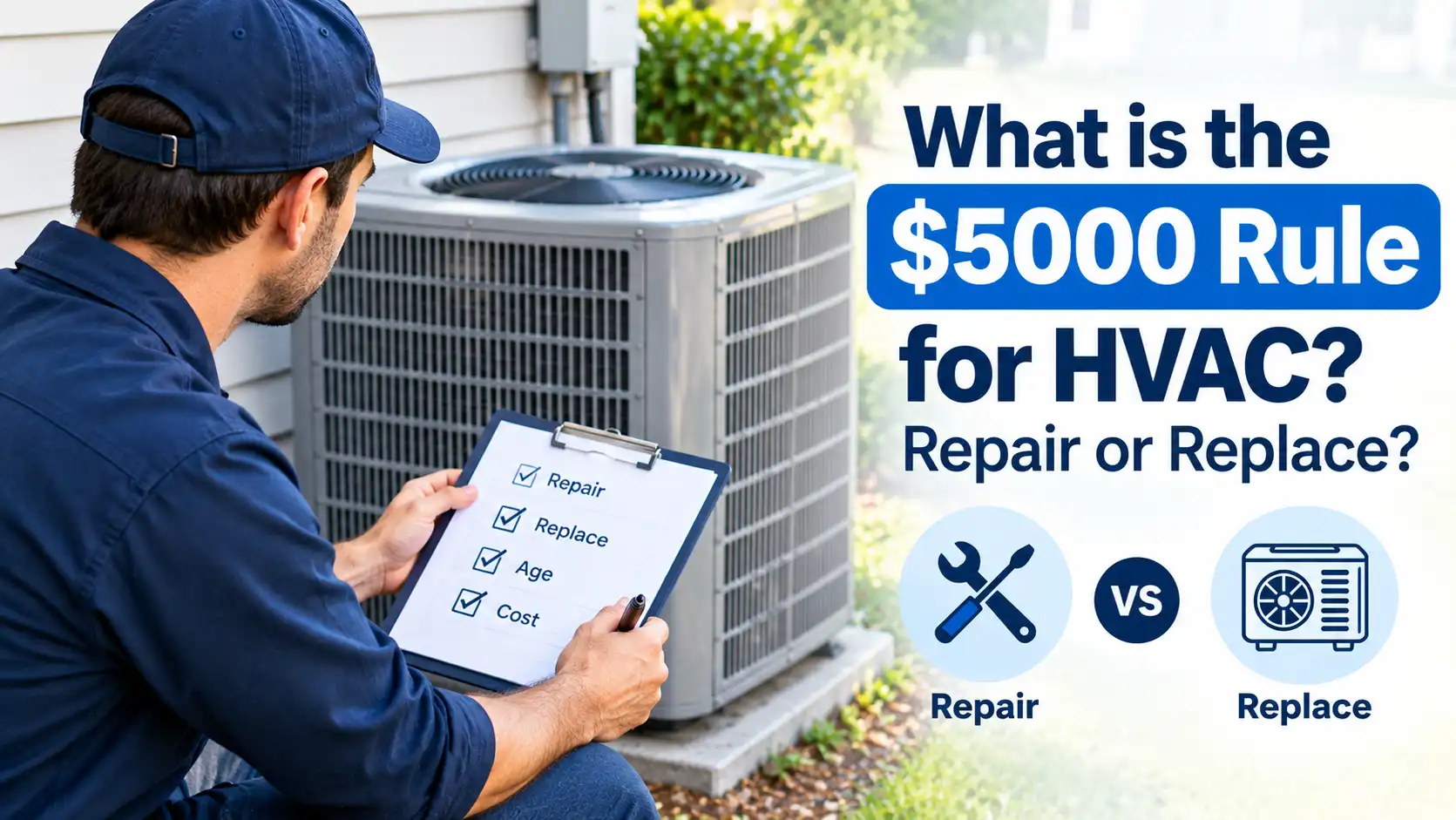
When a heating and air conditioning system begins failing, many homeowners have to ask themselves an important question: Should I Repair My HVAC System or Replace It? It’s true that repairs can be less expensive — at least at first — but multiple repairs on an old unit can add up fast. On the other hand, a new HVAC system requires a bigger upfront investment.
A common rule of thumb homeowners apply when making a decision what is the $5000 rule for HVAC?. This easy-to-understand formula assesses the age of your HVAC system against the potential repair cost. While it is not an official industry standard, it can give you an idea of whether a repair is worth it.
The $5000 Rule and Homeowners
The rule is mainly intended to offer a quick comparison of the cost of an HVAC repair to the age of the equipment.
A cheap fix may be warranted for a comparatively young unit that has otherwise served well but is now acting up. But an expensive repair to an older system could be a red flag for more costs down the road.
The rule can thus help homeowners begin to talk to an HVAC technician about whether further repairs are worthwhile.
HVAC Repair vs Replacement Cost
Before you can make a decision, you need to understand HVAC repair vs. replacement cost.
HVAC repair costs can be as low as minor service work and go up to costly component replacement. Prices vary based on the type of system, damaged part, labor cost, location, and the complexity of the repair.
Replacement costs are much higher, however, and may include new equipment, installation labor, modification of ductwork, electrical work, permits, and more.
However, replacement can provide benefits that repair can’t, such as improved energy efficiency, enhanced reliability, newer technology, and a new equipment warranty.
Instead of only considering the cost of your repair today, consider how much your old system will cost to run for the next few years.
You will read more about AC Repair Cost Houston 2026
When to Replace Your HVAC System
When to upgrade equipment within an HVAC system can be difficult to know, since age is not the only telltale sign that replacement is required.
Consider replacing it if it’s an old unit, if it’s in need of constant repairs, if its efficiency is declining, or if it’s not able to keep you comfortable.
A high repair cost for an older system might be a hint not to throw more money at it. HVAC Replacement may be more appealing if the repair is to a significant part or if it has already been repaired several times.
Energy efficiency is also another solid thing to consider. Some older units can use more energy than newer, higher quality ones, properly sized equipment. If you’re paying more for utilities and feeling less comfort, you might consider having an HVAC pro take a look.
HVAC Age and Repair Cost Calculator
The HVAC age and repair cost calculator can help you more easily use the $5000 rule.
You can calculate the basic value by hand:
System Age × Average Repair Cost = Result
A few examples:
| HVAC Age | Repair Cost | Calculation | Result |
| 5 years | $400 | 5 × $400 | $2,000 |
| 8 years | $500 | 8 × $500 | $4,000 |
| 10 years | $600 | 10 × $600 | $6,000 |
| 12 years | $500 | 12 × $500 | $6,000 |
| 15 years | $400 | 15 × $400 | $6,000 |
Results over $5,000, according to the basic rule, means replacement should be strongly considered.
But this calculation doesn’t consider every relevant factor.
The calculation is a tool to help guide you, not a guarantee.
Signs You May Need to Replace Your HVAC System
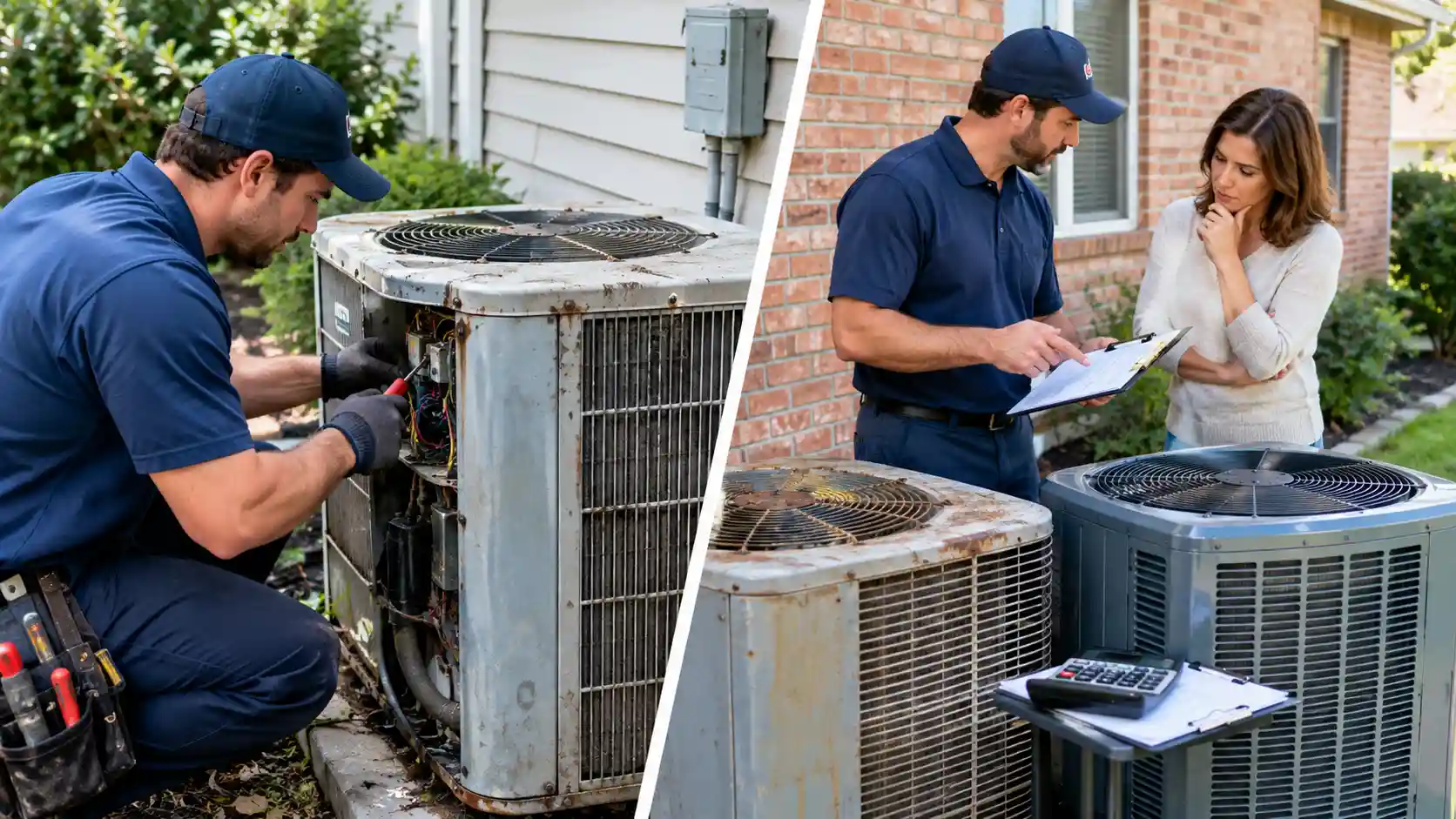
There are a few telltale signs that you need a new HVAC system.
1. Repairs Become Frequent
Repeated HVAC repairs can get expensive fast if you’re making appointments regularly. Several breakdowns may mean the unit is near the end of its service life.
2. Energy Bills Are Going Up
Energy use may gradually rise as HVAC equipment ages and becomes less efficient. But yes, there are a lot of other things that influence energy bills, such as insulation, thermostat settings, duct leaks, and weather.
3. Uneven Temperatures
If you have rooms that are always too hot or too cold, it’s a sign of an HVAC issue. Flow restrictions, ductwork problems, the wrong size unit, and old equipment can all be the culprit.
4. Strange Noises
Strange banging, grinding, rattling, or squealing noises are worth investigating. Some problems are fixable, but persistent mechanical troubles could be considered a sign that replacement is becoming more feasible.
5. Poor Heating or Cooling Performance
Long System Run Times. You should be concerned if your system has long run times, but you still can’t achieve the right temperature indoors.
6. Old Equipment
HVAC systems have a limited service life. As equipment ages, replacement parts can become harder to find, and the cost of repairs can go up.
Things to Think About Other than the $5000 Rule
The $5000 rule is practical, but it shouldn’t be the only factor you consider.
1. System Age
One of the most crucial factors is age. It makes more sense to repair a relatively new system than a very old system.
2. Repair History
Consider how much you have already had to spend on repairs in recent years. A single repair is one thing; repeated breakdowns are another matter.
3. Energy Efficiency
Older HVAC systems may not be as energy efficient. Have a qualified professional do a cost comparison estimate of the anticipated running cost of your existing system versus that of an appropriately sized replacement.
4. Warranty Coverage
See if your appliance, or parts from it, are still under the manufacturer’s or service warranty. Having coverage under warranty can alter the whole financial equation.
5. Whole System Condition
If your HVAC unit is a bit older, you may want to get a pro to tell you if your HVAC unit is overall healthy or showing signs of age in every cranny.
6. Comfort and Reliability
Even if an old system can be fixed in a technical sense, it is a hassle to have it breaking down constantly. Think about how reliable you want your heating and cooling system to be.
To Fix or Replace an HVAC System?
The age, repair cost, and the quality, efficiency, and extent of prior repairs of your system are taken into account.
If you own a relatively new HVAC system, it may be worth repairing based on the cost. But if it’s such an old system that keeps breaking down and needing a $1,000 repair bill, I would consider replacement options.
Before you make a final decision, 75 Degree AC an HVAC professional explain the issue, give you a detailed repair estimate, and an replacement estimate. You can make an informed decision by comparing both options and understanding the short-term and long-term costs.
Keep in mind that the $5000 rule of HVAC is a rule of thumb, not an industry standard. While it can help you make the decision, an HVAC system’s optimal choice is always based on its specific condition and needs.
Conclusion
The $5,000 rule for HVAC is a simple way to compare an HVAC system’s age to the cost of a recommended repair. Multiplying the repair cost by the age of the system, they can get a quick idea on whether replacing should be on their minds.
But energy efficiency and maintenance history, warranty coverage, comfort, reliability, and overall equipment condition matter just as much. Knowing the cost of HVAC repair vs. replacement and the signs you need a new HVAC system will assist you in making a sound choice.
If your heating and cooling system is getting old or giving you problems, don’t just buy a repair — get a replacement estimate, too.
FAQs
Is the $5,000 rule an official HVAC guideline?
The $5,000 rule is a rule-of-thumb financial guide and is not an official standard of the HVAC industry. It’s meant to serve as a guide for homeowners to help them determine whether the age of their equipment should be considered when repair costs are mounting.
Should I be replacing my HVAC system because of the $5,000 rule?
No. However, High Repair Cost Doesn’t Mean You Must Replace Your HVAC System If a repair tops $5,000, that doesn’t necessarily mean your HVAC unit is beyond repair. Other factors to consider are the condition, operational efficiency, repair history, warranty coverage, and estimated remaining service life of the system.
How do you know how much energy your furnace uses?
A trained HVAC technician can give you a written estimate showing the amounts for the defective component, the parts, labor, and any other fees. Getting estimates might also help you understand how much the repair will cost.
Should I replace my old HVAC system?
Possibly, but not always. An old unit that is well maintained and has been reliable could have years of life still left to be shared. Replacement usually becomes better when age combined with a history of frequent repairs, poor efficiency, or poor performance is involved, generally.
Should I get a second opinion before replacing my HVAC system?
A second professional opinion is advisable in most cases, other than in situations in which a sizable repair is needed, or you are apparently on the edge of replacing your entire system. It allows you to shop around for the diagnosis, the repair, and even second replacement estimates without having to make a decision.

