
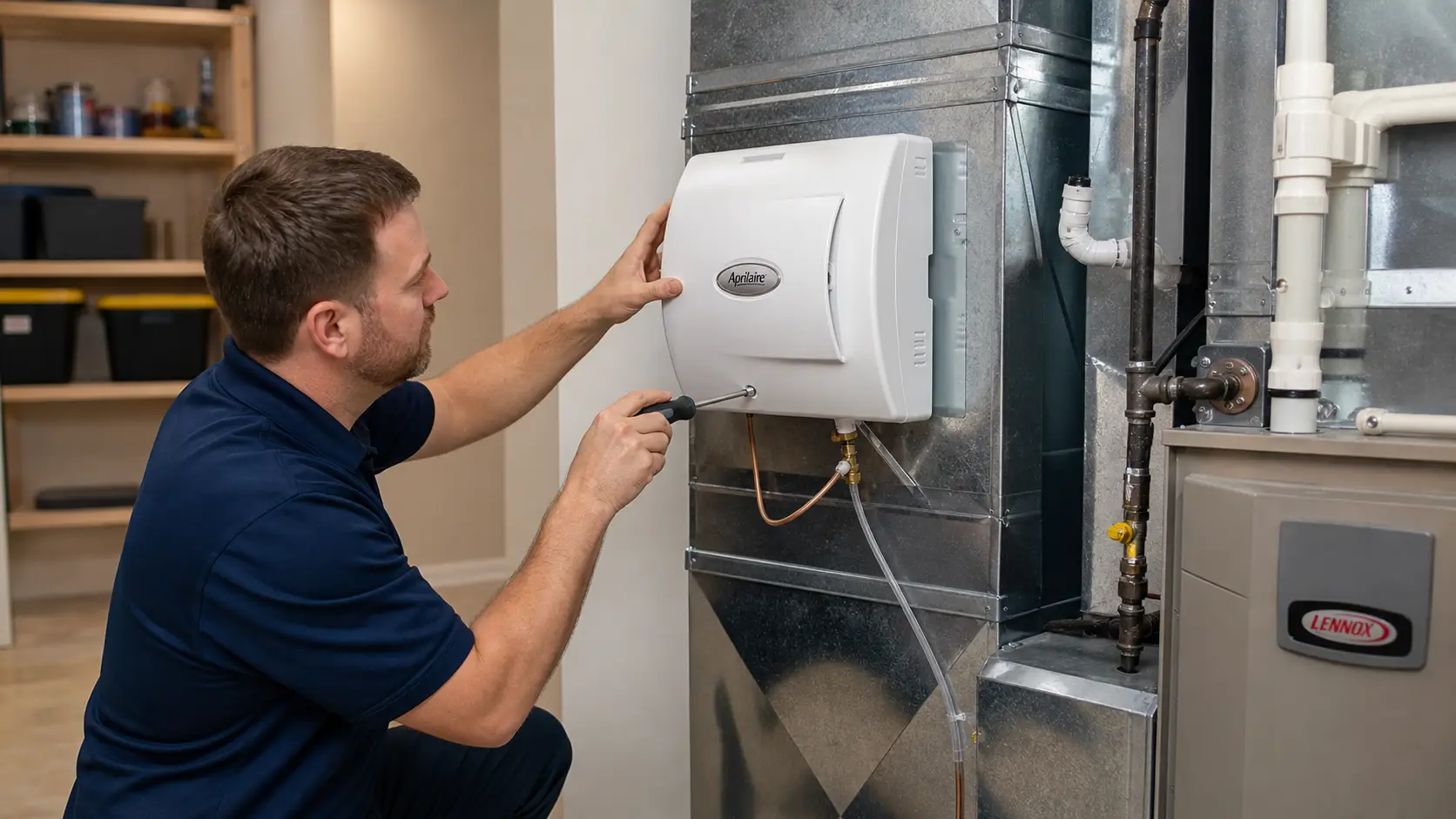
A whole-home humidifier is usually installed near the furnace or air handler and connected to the central ductwork. The right spot must have suitable airflow, water access, drainage, service space, and safe duct access.
Humidifier installation location depends on the humidifier type and HVAC layout. A bypass unit may work on the supply or return side, while other models have more specific placement rules. Always follow the unit’s installation manual.
Quick Answer
A whole-home humidifier is installed directly on the supply or return ductwork near the furnace or air handler. Most installers prefer the return duct because it carries cooler air, which holds moisture better and keeps water away from the furnace’s electrical parts. The exact location still depends on your humidifier type, duct space, water access, and drain access.
Return Duct vs. Supply Plenum: Which Is the Best Location to Install a Whole-Home Humidifier?

Every whole-home humidifier connects to one of two spots: the return air duct or the supply plenum. Both carry air from your furnace or air handler through your home.
The return duct pulls cool air back toward the furnace. The supply plenum pushes warm air out to your rooms. Where to place a humidifier between these two spots changes how well it works and how safe it is.
| Factor | Return Duct | Supply Plenum |
| Air temperature | Cooler air | Warmer, post-furnace air |
| Moisture holding capacity | Lower | Higher |
| Leak risk | Away from furnace electronics | Sits above or near the furnace |
| Common use | Preferred by most manufacturers | Used when return space is limited |
The best location is not always “the return duct” as a blanket rule. The best location is the one that matches your humidifier’s approved duct configuration, while still giving you proper airflow, water and drain access, room to service the unit, and protection from leaks or freezing. A bypass humidifier and a steam humidifier do not always want the same spot.
Why Installers Usually Recommend the Return Duct
A return-side location can be practical when the supply plenum has limited space. It can also make mounting easier around some evaporator coil layouts.
However, return-side placement is not automatically better.
The humidifier still needs the right airflow, water connection, drain path, and service clearance. A poorly sealed opening can also create air leakage. A water leak near electrical components can cause property damage.
The supply side has its own benefits. Some fan-powered humidifiers are designed for the hot air supply plenum. AprilAire notes that its power humidifiers are designed for supply-side installation, with return-side installation possible in certain layouts when the required water temperature is provided.
So, do not choose a side based only on a general rule. Match the humidifier to the HVAC system.
Where Should Different Types of Whole-Home Humidifiers Be Installed?
Humidifier placement is not one size fits all. The three main types each have their own duct and mounting needs.
Bypass Humidifier
Bypass humidifiers mount on the return or supply duct and use a separate bypass duct to pull air across a wet evaporator pad. This bypass duct connects the supply side to the return side, so you need open space on both.
Fan-Powered Humidifier
Fan-powered humidifiers work the same way but use a built-in fan instead of relying only on the furnace blower. They still mount on the ductwork, but they need less bypass space and can work in tighter duct layouts.
Steam Humidifier
Steam humidifiers inject steam directly into the supply duct through a dispersion tube. They usually mount on a nearby wall, not directly on the duct, and connect to the ductwork with a short steam line. Because they run on their own heating element, they also need a dedicated electrical circuit.
Knowing your humidifier type before you start narrows down where to place a humidifier a lot faster than guessing at duct space first.
Best Place to Put a Humidifier in a 2-Story House
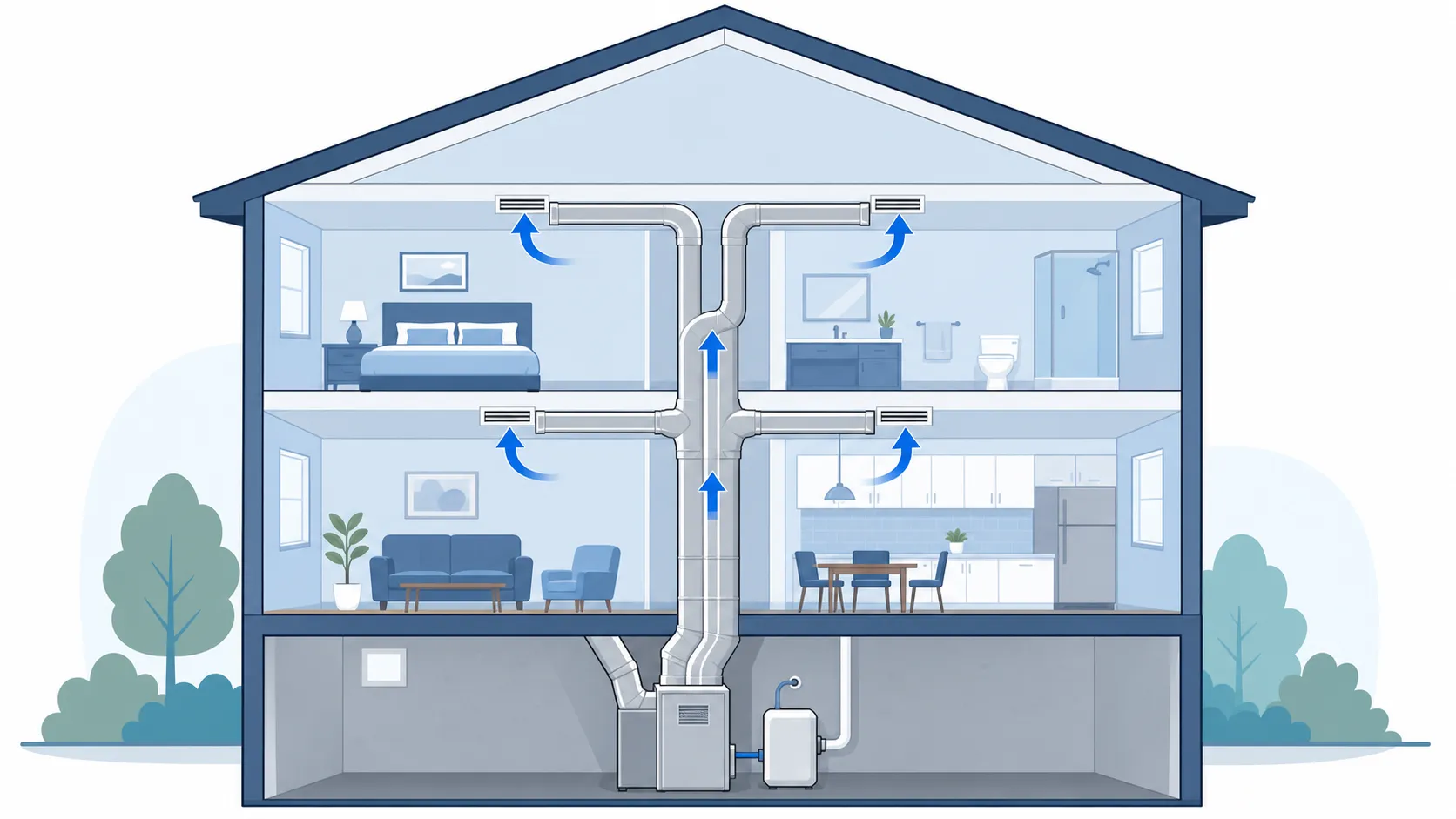
The best place to put a humidifier in a 2 story house is usually not upstairs.
If both floors use the same central HVAC system, one whole-home humidifier can add moisture to the shared air stream. The furnace or air handler location often becomes the most practical installation point.
For example, imagine a two-story home with a furnace in a basement mechanical room. Installing the humidifier near that furnace can allow moisture to enter the central duct system before air travels to both floors.
The situation changes when the home has:
- Separate HVAC systems for each floor
- Separate furnaces or air handlers
- Strongly separated zones
- Poor airflow to the second floor
- A closed-off upstairs area
In these cases, one humidifier may not provide the desired control everywhere.
Do not move the humidifier upstairs just because the second floor feels dry. First check the zoned HVAC system, duct distribution, return airflow, and humidity readings.
A single unit can only control humidity through the air system it serves.
How Close Should the Humidifier Be to the Evaporator Coil?
This detail rarely gets covered, but it matters.
This is an important placement question because many furnace systems also contain an evaporator coil.
Do not assume that any open section beside the coil is safe for mounting.
A humidifier should be positioned according to the equipment’s installation instructions and the actual coil arrangement. The installer must know where the coil slabs, drain pan, and internal components sit before cutting the duct or coil casing.
Carrier cooling-coil instructions state that humidifiers should be mounted to the supply plenum or return duct when possible, with care taken to avoid damaging the coil and with adequate airflow provided.
There is no universal distance that applies to every humidifier and evaporator coil.
That is important.
A fixed “X inches from the coil” rule can be wrong for a particular model. Some systems allow specific mounting positions while others restrict certain areas of the coil casing.
The safest approach is to use the manufacturer’s mounting template and installation manual.
Also consider mineral buildup. Evaporative humidifiers use a water panel that can collect minerals over time. Steam and other humidification systems can have their own water-related concerns.
The goal is to keep moisture where the equipment is designed to handle it, while protecting the evaporator coil, electrical parts, insulation, and ductwork.
What Should You Check Before Choosing the Installation Location?
Before deciding on the whole house humidifier installation location, check these details:
- Duct type: supply, return, or a dedicated steam line
- Airflow direction through that section of duct
- Clear water line access nearby
- A workable drain path, or room for a condensate pump if gravity drainage isn’t possible
- Electrical or low-voltage access for the humidistat and transformer
- Enough service clearance to remove and replace the water panel later
- Safe distance from the evaporator coil
- Protection from freezing if any part of the run passes through an attic or unconditioned space
- Your humidifier’s manufacturer template and clearance instructions
Checking each of these before you cut is the real answer to where do I install a whole home humidifier for almost any home.
Where Should the Humidistat Go?
The humidistat needs to read air that represents your actual living space, not a blast of duct air right off the furnace. Most manufacturers place it on the return duct a few feet from the humidifier, or on an interior wall away from supply vents, exterior walls, and direct sunlight.
A humidistat placed too close to a vent or too close to an exterior wall will give false readings and cause the humidifier to run too much or too little.
What If You Don’t Have Central Ductwork? (Ductless and No-Furnace Homes)
Not every home has a furnace or central ducts to tie into. If you have a ductless mini-split system, radiant heat, or no forced-air system at all, a duct-mounted humidifier will not work.
In that case, a self-contained console or steam humidifier can still cover the whole house. These units mount in a utility room or closet, connect to a water line and drain on their own, and use an internal fan to push humidified air into the space instead of relying on ductwork. This is the practical answer for whole house humidifier installation location in homes built without central air distribution.
Locations and Mistakes to Avoid When Placing a Whole-Home Humidifier
Some spots and habits cause more problems than they solve. Avoid these:
- Mounting directly above the furnace cabinet, where a leak can hit electrical parts
- Installing in an unconditioned attic without checking freeze risk on the water line
- Placing the unit too close to the evaporator coil
- Cutting into a duct section that blocks future service access
- Skipping the manufacturer’s clearance template to save time
- Installing a bypass duct too close to the main trunk line, which causes uneven moisture distribution to rooms farther from the unit
- Ignoring drain slope, which leads to standing water and mold risk inside the cabinet
- Placing the humidistat next to a supply vent, exterior wall, or window
Most of these mistakes show up months later as leaks, mold, or a system that never seems to hit the humidity setting you want.
When Should an HVAC Professional Choose the Humidifier Location?
A professional should assess your HVAC configuration before anyone cuts into ductwork, especially if you have a variable-speed blower, a zoned system, a heat pump, or limited access to water and drain lines. A trained technician checks airflow direction, confirms duct space, plans the water and drain connection, and verifies the location meets your humidifier’s manufacturer specs before doing any work.
If you’re in the Houston area and want a professional opinion before you commit to a spot, 75 Degree AC offers humidifier installation in Houston for homeowners who want the location, ductwork connection, and controls set up correctly the first time. Once you’ve confirmed the right location for your home, our team at 75 Degree AC can handle the connection, testing, and final setup so you’re not guessing at water lines or drain slope on your own.
Ready to get your humidifier placed and installed correctly? Contact 75 Degree AC to schedule a placement assessment for your home.
For the full step-by-step installation process once your location is confirmed, see our complete guide on how to install a humidifier for whole house.
For general guidance on healthy indoor humidity ranges, the EPA’s indoor air quality resources and ASHRAE both publish standards worth checking before you set your target humidity level.
Frequently Asked Questions
Should a humidifier go on the intake or outlet of the furnace?
Most manufacturers recommend the return side, which acts as the intake into the furnace. Some models are built for the supply side instead, so always check your unit’s manual first.
Does it matter if I install on the left or right side of the plenum?
Not directly. What matters is airflow direction, clearance for service, and distance from the evaporator coil, not which physical side of the plenum you use.
Can a whole-house humidifier go in the attic?
Only if the attic space is conditioned or the water line is fully protected from freezing. Unprotected attic installs are one of the most common causes of winter water line failures.
Does upstairs humidity suffer if the unit is only downstairs?
Usually not, as long as the ductwork is shared between floors. If the upstairs runs on a separate HVAC system, it needs its own humidifier.

