
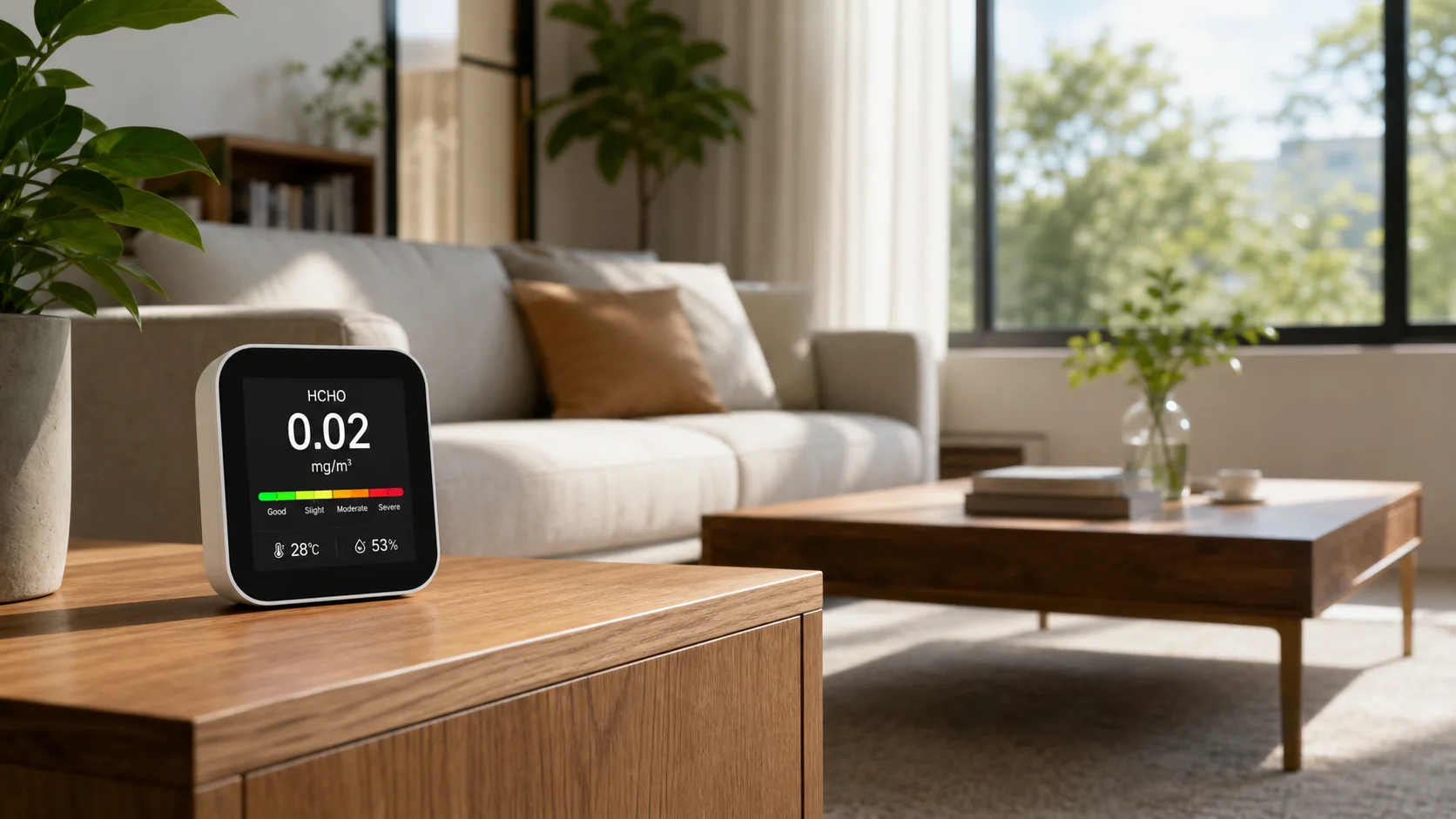
HCHO is also a frequently included metric on air monitors, as it may point to the existence of formaldehyde, a substance that furniture, building materials, household goods, and combustion sources can give off.
HCHO stands for formaldehyde, a colorless, highly pungent gas that is present in both indoor and outdoor air. Indoor air often has a larger contribution of formaldehyde than outdoor air, since a variety of everyday household items release it more or less continuously.
When an air quality monitor displays a reading for HCHO, what it’s really showing is the concentration of formaldehyde in the air you are breathing. On the instrument, the value can be given in mg/m3 (milligrams per cubic meter) or in ppm (parts per million).
So your HCHO air quality reading is really just how much formaldehyde is in your air.
Why Is HCHO Present In Indoor Air?
There are multiple sources of formaldehyde in your home. One of the largest sources is pressed wood products made with certain adhesives.
The U.S. Environmental Protection Agency (EPA) states that formaldehyde can be emitted from products including particleboard, medium-density fiberboard (MDF), hardwood plywood, cabinets, shelving, and furniture. Because of its high resin content, MDF tends to emit more formaldehyde than other wood products.
Other potential sources include:
- New furniture and cabinets
- Pressed-wood flooring or shelving
- Glues and adhesives
- Certain paints and coatings
- Textiles and permanent-press fabrics
- Tobacco smoke
- Unvented fuel-burning appliances
- Some household products
Formaldehyde emissions from new products may be initially higher and decline over time, but emission rates do change with time. Temperature and humidity can also influence the rate of formaldehyde emissions.
HCHO Air Quality Meaning
In simple terms, HCHO air quality is a measure of formaldehyde concentration in the air.
A reading on the low side tells you there’s less formaldehyde in the air; a reading on the high side tells you there’s more of it. But you shouldn’t just take one number at face value without thinking about what units it’s using, how accurate the sensor is, whether it’s calibrated, and how it measures.
Consumer-grade air-quality monitors are useful gadgets for noticing changes or spotting potential problems, but that doesn’t necessarily mean they are instruments of lab quality.
If you notice a sudden spike in your HCHO reading after purchasing new furniture, installing cabinets, painting, or otherwise bringing new materials into your home, that shift is probably worth a closer look.
What Happens If You Are Exposed to Large Amounts of Formaldehyde?
Your eyes, nose, and throat can be irritated by formaldehyde. Symptoms of high exposure include watery and burning eyes, coughing, wheezing, and difficulty breathing. According to the EPA, very high levels of formaldehyde exposure may also trigger immediate effects among people with asthma. It’s also harmful to your health if you’re exposed to too much of it, or to lower amounts over a long period of time. Since formaldehyde is classified as a human carcinogen, minimizing high exposure is the best way to keep the air in your home clean.
That said, not every HCHO number you see is cause for panic. The potential for an effect depends on the concentration, duration, ventilation rate, and the sensitivity of the individual.
Safe Limit for HCHO Concentration
How much HCHO is safe is among the most commonly asked questions on this topic.
The World Health Organization (WHO) recommends that indoor formaldehyde levels be limited to 0.1 mg/m3 as a 30-minute average, to avoid irritant effects at any age. WHO advises not exceeding this 30-minute value.
Note that this is a WHO guideline, not a legally binding limit in every country, and it doesn’t necessarily mean your consumer monitor is accurate enough for anything beyond general, informative purposes.
The EPA has not established an official safe level for formaldehyde in indoor air, though it does provide toxicological information on the chemical’s health effects.
While the WHO guideline is a useful point of reference if your monitor reports HCHO in mg/m3, keep in mind that professional testing may be needed for anything more conclusive.
How to Reduce HCHO in the Home

If you’re wondering how to reduce HCHO in the home, the good news is that several effective strategies can help.
1. Improve Ventilation
Ventilation is one of the most effective ways to reduce indoor formaldehyde levels. Open windows and doors when outdoor conditions allow, and use exhaust fans where available. Ventilation is especially important right after new furniture, cabinets, flooring, or other formaldehyde sources have been brought into a home. Both the WHO and the EPA recognize ventilation as an effective way to reduce indoor exposure.
2. Watch Out for New Furniture
New pressed-wood furniture can give off formaldehyde. When selecting new products, choose those certified for lower formaldehyde emissions or that meet relevant emission regulations. Airing out new furniture in a well-ventilated room can also help lower indoor levels.
3. Control Moisture and Temperature
The EPA advises maintaining indoor temperature and humidity within a comfortable range by using air conditioners or dehumidifiers. There’s no real downside to keeping indoor conditions reasonably comfortable and humidity levels in check.
4. No Indoor Smoking
Tobacco smoke is a significant indoor source of formaldehyde, along with many other pollutants. A smoke-free indoor environment further improves indoor air quality.
5. Handle Air-Quality Meters With Care
An HCHO monitor allows you to track fluctuations in indoor air quality. If a reading rises sharply, think about whether there’s been a recent change in your surroundings: new furniture, construction work, painting, or reduced ventilation. But don’t rely on a single low-cost detector to confirm a serious indoor-air issue. If measurements stay abnormally high, a professional evaluation can offer more certainty.
Is HCHO the Same as VOC?
Not quite. HCHO is formaldehyde, while VOC stands for volatile organic compounds a broad group of chemicals that can turn into gas and enter the air.
Formaldehyde is a volatile organic compound, so it falls within the VOC category; it can be thought of as one of many VOCs. An HCHO reading doesn’t refer to the concentration of all VOCs in the air only to the concentration of formaldehyde specifically. This is why HCHO and TVOC readings are usually displayed separately on a monitor.
How to Lower HCHO Levels
Indoor air pollution is, in many cases, easier to prevent than to remediate. Choose low-emitting building products and furnishings when you can, ventilate adequately, avoid smoking indoors, and keep temperature and humidity at comfortable levels.
If you notice eye, nose, or throat irritation after redecorating a room or bringing in new furniture, the first step is to ventilate the space and try to identify the potential source. For persistent symptoms, consistently high readings, or both, professional indoor-air testing can confirm whether formaldehyde levels are elevated and help identify the source.
Conclusion
So, what is HCHO in air quality? HCHO is the short form for formaldehyde, a gas that may be emitted from certain building materials, furniture, household products, and combustion sources.
The HCHO reading on an air-quality monitor reflects the amount of formaldehyde in the air. The WHO has set a 30-minute indoor guideline of 0.1 mg/m³, while the EPA has not established an official safe level for formaldehyde in indoor air.
If your HCHO level is high, you can reduce exposure by increasing ventilation, managing temperature and humidity, avoiding indoor smoking, and choosing lower-emission products.
FAQs
What is a good HCHO value?
The WHO guideline for formaldehyde in indoor air is 0.1 mg/m3 as a 30-minute time-weighted average. This should be seen as a health-based guideline, not a legally binding value.
What raises HCHO levels in a house?
Common sources include pressed-wood furniture and cabinets (such as MDF, particleboard, and plywood), adhesives, certain coatings, tobacco smoke, and some combustion processes.
How do you get rid of HCHO?
Ventilate the space, manage temperature and humidity, avoid smoking indoors, and choose furniture and building materials that emit less formaldehyde. These steps can help minimize exposure.