
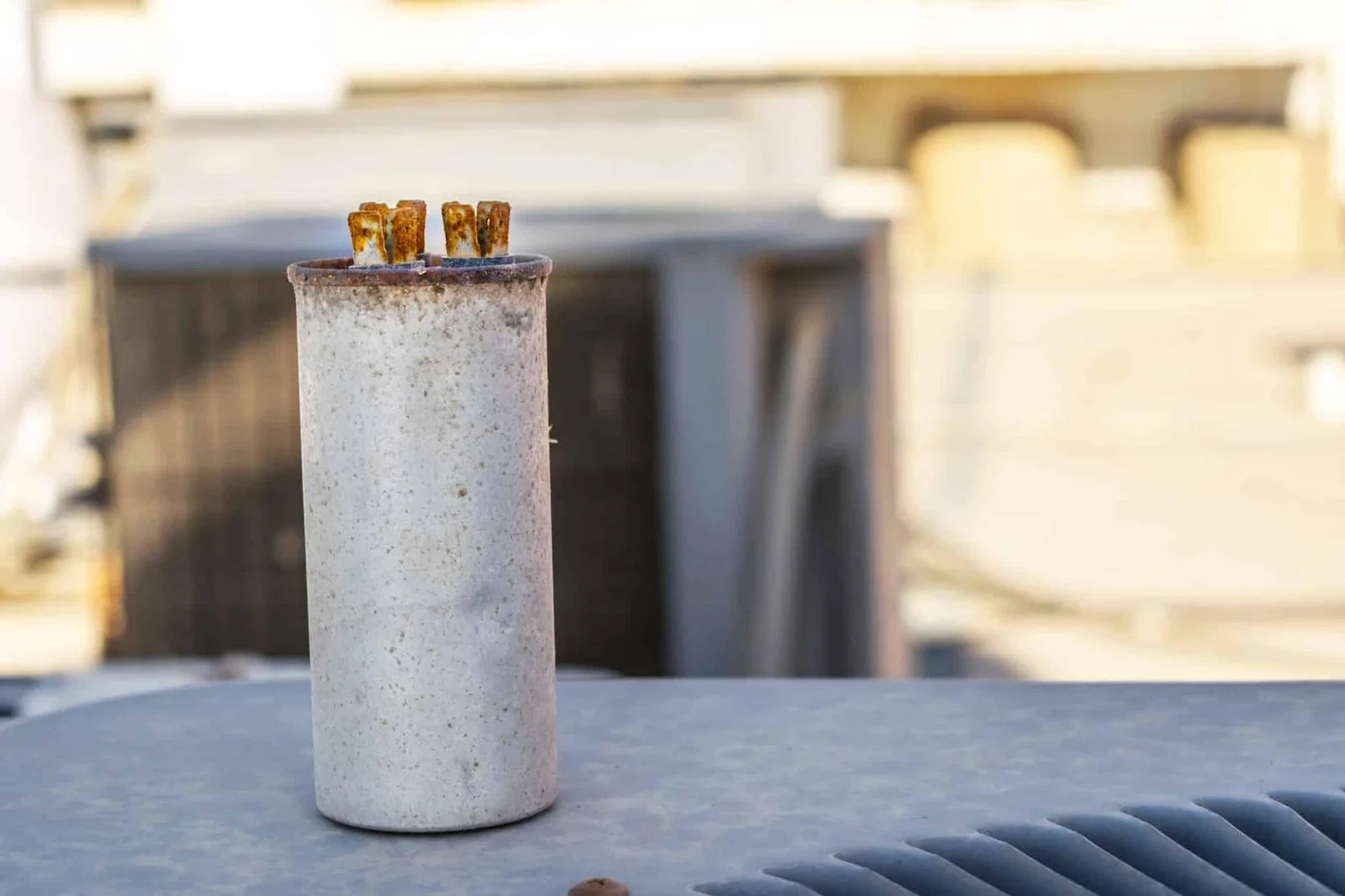
Every May, right before Houston’s first real 95°F stretch, our phones start ringing with the same complaint: “my AC won’t start, it’s just humming.” Nine times out of ten, the culprit is a $40 part sitting inside the outdoor unit. Catch it early and it’s a quick, affordable repair. Ignore it through a few more hot weeks and that same $40 part takes a $2,500-$4,000 compressor down with it.
That part is the run capacitor, and recognizing AC capacitor failure symptoms early is the single biggest money-saver in residential HVAC. Here’s what’s actually happening inside that little can, the exact symptoms to watch for, and what separates a $200 fix from a $400 emergency call.
What Is an AC Capacitor?

Your outdoor condenser has two motors that need a serious kick to get moving: the compressor and the condenser fan. Neither one can start on line voltage alone; they need a short, powerful burst of stored energy first. That’s the capacitor’s job.
Picture it as a tiny battery that only lives for about half a second at a time. Inside the can, thin metal plates sit separated by an insulating film. That film the dielectric charges up and dumps energy into the motor the instant your thermostat calls for cooling.
Most residential systems use a single “dual-run” capacitor that handles both jobs in one can. You’ll see two numbers stamped on the side, something like “45/5 µF.” The first number is the compressor rating, the second is the fan.
AC Capacitor Failure Symptoms
A failing AC capacitor can prevent your air conditioning system from starting properly, reduce energy efficiency, and place unnecessary strain on critical components such as the compressor and fan motor. Recognizing the early warning signs of capacitor failure can help you avoid unexpected breakdowns, higher utility bills, and costly repairs. Below are the most ac capacitor failure symptoms homeowners should watch for. If yours has already failed, our Houston AC repair technicians can test and replace it the same day.
Why Houston Capacitors Fail Faster Than Almost Anywhere Else
Heat is the single biggest killer of run capacitors, and the dielectric film degrades exponentially faster as ambient temperature climbs. National Weather Service data for Houston shows the metro averages 99 days a year above 90°F and 32 days above 95°F, well ahead of Dallas (roughly 85 days above 90°F) and nowhere close to a city like St. Louis (about 38).
It’s not just outdoor air temperature either. A condenser sitting in direct sun on the south or west side of a house can push internal capacitor temperature past 140°F on a July afternoon.
Voltage sags and brief brownouts are common between 4 PM and 8 PM in July and August. Every time the system shuts off and restarts, the capacitor absorbs the full inrush load again. A capacitor in a milder climate might see two clean start cycles a day. One in Cypress or Spring during a conservation event can see six or seven in a single afternoon.
Seven AC Capacitor Failure Symptoms to Watch For
These are the bad AC capacitor symptoms we see most often on Houston AC capacitor failure symptoms service calls, in the order homeowners usually notice them.
1. The Unit Hums but the Compressor Won’t Start
This is the textbook sign. You hear the contactor click and a low electrical hum from outside, but the compressor never spins up. After 30–60 seconds, an internal overload trips and it goes quiet, then tries again a few minutes later. Each attempt adds more wear.
2. The Outdoor Fan Is Slow, Sluggish, or Not Spinning at All
The fan side of a dual-run capacitor can fail on its own, independent of the compressor side. If the fan isn’t moving while the compressor runs, don’t let it sit without airflow across the coil. The compressor can overheat within five to ten minutes.
3. The Breaker Trips Shortly After Startup
A weak capacitor still tries to start the compressor but pulls excessive amperage doing it, sometimes double the rated load. If you’re resetting the breaker more than once a week, stop resetting it and get it checked. Repeated trips wear down both the breaker and the compressor windings.
4. Cooling Feels Weaker and the Electric Bill Is Creeping Up
A marginal capacitor lets the system keep running, just less efficiently. The compressor works harder and longer to hit the same temperature. We’ve seen Houston homes where a $35 part was quietly adding $80–90 a month to the electric bill, and the homeowner just assumed the system was “getting old.”
5. A Buzzing or Chattering Sound at Startup
Listen right at the outdoor unit when the system first kicks on. A healthy start is one clean click followed by the compressor and fan spinning up together. A failing capacitor sounds more like a stutter or buzz as the contactor keeps trying to find enough kick to start the motor.
6. The AC Turns Off on Its Own Mid-Cycle
If the system shuts down before it reaches your thermostat setting not because it satisfies the call, but randomly a degrading capacitor is one of the most common causes.
7. A Visible Bulge, Oily Residue, or Rust at the Terminals
With the disconnect pulled, you can look at the can itself. A domed top or wet residue means it’s already past failure. This is also the point where DIY should stop: a capacitor can hold a dangerous charge for several minutes after power is cut, even when it looks “dead.”
If you’re seeing even one of these signs of a bad capacitor on your AC unit, get a meter on it within days, not weeks. A AC capacitor failure symptoms testing at 80% of spec might last another week or it might not survive the next hot afternoon.
What a Real Capacitor Diagnostic Looks Like
When a 75 Degree AC technician gets a no-cool call, the first stop is the thermostat confirming the call for cooling and ruling out something simple. About half of May’s “AC is dead” calls turn out to be thermostat issues, not the condenser at all.
Once that’s ruled out, we pull the disconnect, open the access panel, and discharge the capacitor with an insulated bleed resistor before touching anything skipping this step is how people get hurt. Every technician on our team is trained on capacitor safety and works under Texas license TACLA72152E.
The capacitor then goes on a Fieldpiece clamp meter with capacitance mode, which reads the actual µF against the rating printed on the can. Anything below 90% of spec gets replaced. We also check the contactor for pitted points, test compressor winding resistance, and check the fan motor because sometimes a failed capacitor takes a motor down with it, and sometimes a struggling compressor was disguised as a capacitor problem the whole time.
Houston ratings (35/5, 40/5, 45/5, 50/5 µF) plus larger sizes for 5-ton systems, so about 90% of jobs are done in a single visit. After install, we verify inrush amperage, run voltage, and refrigerant sub cool/superheat before calling it, usually 30-45 minutes total.
AC Capacitor Replacement Cost in Houston
A standard capacitor replacement runs $150-$250 during business hours for a typical residential system. After-hours, holidays, or hard-access units (rooftop, tight side yards, second-story condensers) run $250-$400. That covers the part, labor, and a startup check.
If your system is past year 10, a hard-start kit ($50-$80 add-on) is usually worth pairing with the new capacitor; it buys the compressor two to three more years by softening every future start.
If you’re not sure where your system stands, an AC tune-up will catch a marginal capacitor before it leaves you sweating in August. We measure capacitance as part of every standard maintenance visit, replace anything reading below 95% of spec, and document the readings so you can track degradation year over year.
When Replacing the Capacitor Stops Being the Right Call
If we’re already at your house replacing a ac capacitor failure symptoms and we also find high amp draw on the compressor, refrigerant leaking from the coils, and a pitted contactor that’s not a $40-part problem anymore. That’s a system on borrowed time. Houston AC systems average a 12-15 year lifespan, shorter along the humid coastal edge.
Past year 12, with multiple components failing together, a full AC replacement usually makes more financial sense than another round of repairs. We won’t push a replacement on a system that just needs a capacitor that’s still the cheapest, lowest-risk fix in HVAC when it’s the actual problem.
Not sure where your system stands? An AC tune-up measures capacitance as part of every visit and flags anything reading below 95% of spec before it strands you on the hottest day of the year.
When to Call 75 Degree AC
If your AC has stopped cooling, the breaker keeps tripping, or you’re hearing a hum with no compressor start, contact us to 75 Degree AC. We’ve been Houston’s same-day capacitor and compressor call since 2016, licensed under TACLA72152E, with vans stocked for same-visit repairs across the metro.
If it hasn’t failed yet, an AC tune-up catches a marginal capacitor before it does and if it already has, our emergency AC repair team keeps dispatch open around the clock for the inner Houston core and suburbs.
FAQs
What are the main AC capacitor failure symptoms?
Humming with no compressor start, a slow or stalled outdoor fan, breaker trips right after startup, weaker cooling paired with rising bills, buzzing at startup, random mid-cycle shutoffs, and visible bulging or corrosion on the can itself.
How much does AC capacitor replacement cost in Houston?
Most jobs run $150-$250 during business hours, $250-$400 after-hours or for hard-access units. Be cautious of any quote under $90 that’s usually a bait price or an unlicensed tech.
How long does an AC capacitor last in Houston?
Typically 5-7 years inland, 4-6 near the coast. Heat, grid stress, and humidity all shorten the lifespan compared to milder climates.
Can I replace an AC capacitor myself?
It’s possible, but not recommended unless you know how to safely discharge stored energy after the disconnect is pulled. A capacitor can hold a dangerous charge for several minutes after power is cut most DIY injuries happen right at that step.
Will a bad capacitor damage my compressor?
Yes, eventually. A weak capacitor forces the compressor to draw higher amperage on every start, which heats and degrades the motor windings over time. A capacitor that costs $200 to fix today can turn into a $2,500-$4,000 compressor replacement within a season or two if it’s ignored.
Should a capacitor be replaced during a routine tune-up?
Only if it’s reading below 95% of spec. A healthy capacitor doesn’t need preventive replacement the failure mode is sudden enough, and the part cheap enough, that catching it at the annual tune-up is the right cadence.
A failing capacitor can look identical to a dozen other electrical issues from the outside — our AC diagnostic service tests the part directly instead of guessing.