
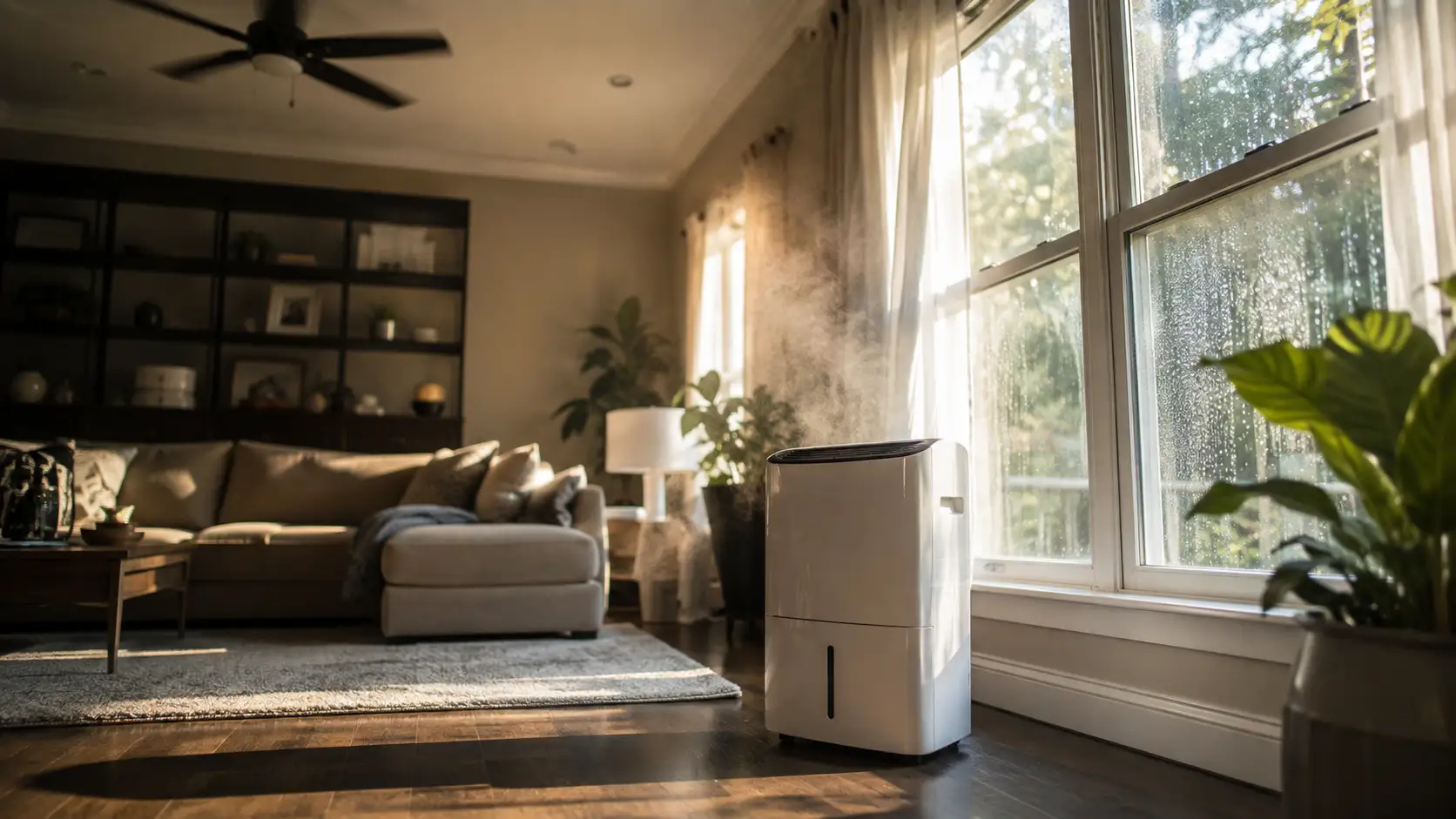
A dehumidifier does not cool a room the way an air conditioner does. It draws moisture out of the air, helping to make the room feel less stuffy and more pleasant. A refrigerant dehumidifier also generates heat in the process; thus, the room temperature may remain the same or increase a little.
This can seem confusing in hot temperatures. The trick is to decouple air temperature from humidity.” If the temperature on the thermometer stays the same, but the humidity drops, your body can more quickly shed heat through sweat.
The Short Answer: No, But It Can Make a Room Feel Cooler
A dehumidifier is built to eliminate water vapor, not chill a room. The air conditioner takes heat from inside the home and expels it outside. The main use of a dehumidifier is to manage the level of moisture in the air in the room.
This difference is important since thermal comfort is affected by dampness. A room at 75 degrees with high relative humidity can seem sticky. The identical room at 75°F with less humidity can seem so much more comfortable.
So, can a dehumidifier cool a room? It can help with the feel of the room, but it doesn’t cool as an air conditioner would.
The U.S. Environmental Protection Agency has stated that indoor relative humidity should be maintained between 30% and 50% when possible.
If the extra moisture is the main problem, a dehumidifier can assist you in achieving that range. It can’t do anything about heat pouring in through sunny windows, a hot roof, insufficient insulation, or an AC system that’s too small.
Why Does Lower Humidity Make a Room Feel Cooler?

Your body uses sweat to release heat. When sweat evaporates from your skin, it carries heat away from your body.
High relative humidity slows this process. The air already contains a large amount of water vapor, so sweat does not evaporate as easily. You may feel hot, sticky, or clammy even when the room temperature is not extreme.
Lower humidity gives sweat more room to evaporate. That can improve thermal comfort without changing the thermostat setting.
For example:
| Room condition | How it may feel |
| 75°F + 70% RH | More humid and muggy |
| 75°F + 45% RH | Drier and generally more comfortable |
This is why people sometimes say a dehumidifier cool the room. The statement describes comfort, not true cooling.
Relative humidity tells you how much water vapor is in the air compared with the amount the air could hold at that temperature. Dew point gives another useful view of moisture in the air.
When the dew point is high, the air contains more moisture. That often makes summer conditions feel heavier because sweat evaporates more slowly.
Wet-bulb temperature also relates to evaporative cooling. It considers both air temperature and moisture. These concepts help explain why two rooms with the same thermometer reading can feel very different.
How Does a Dehumidifier Actually Work?
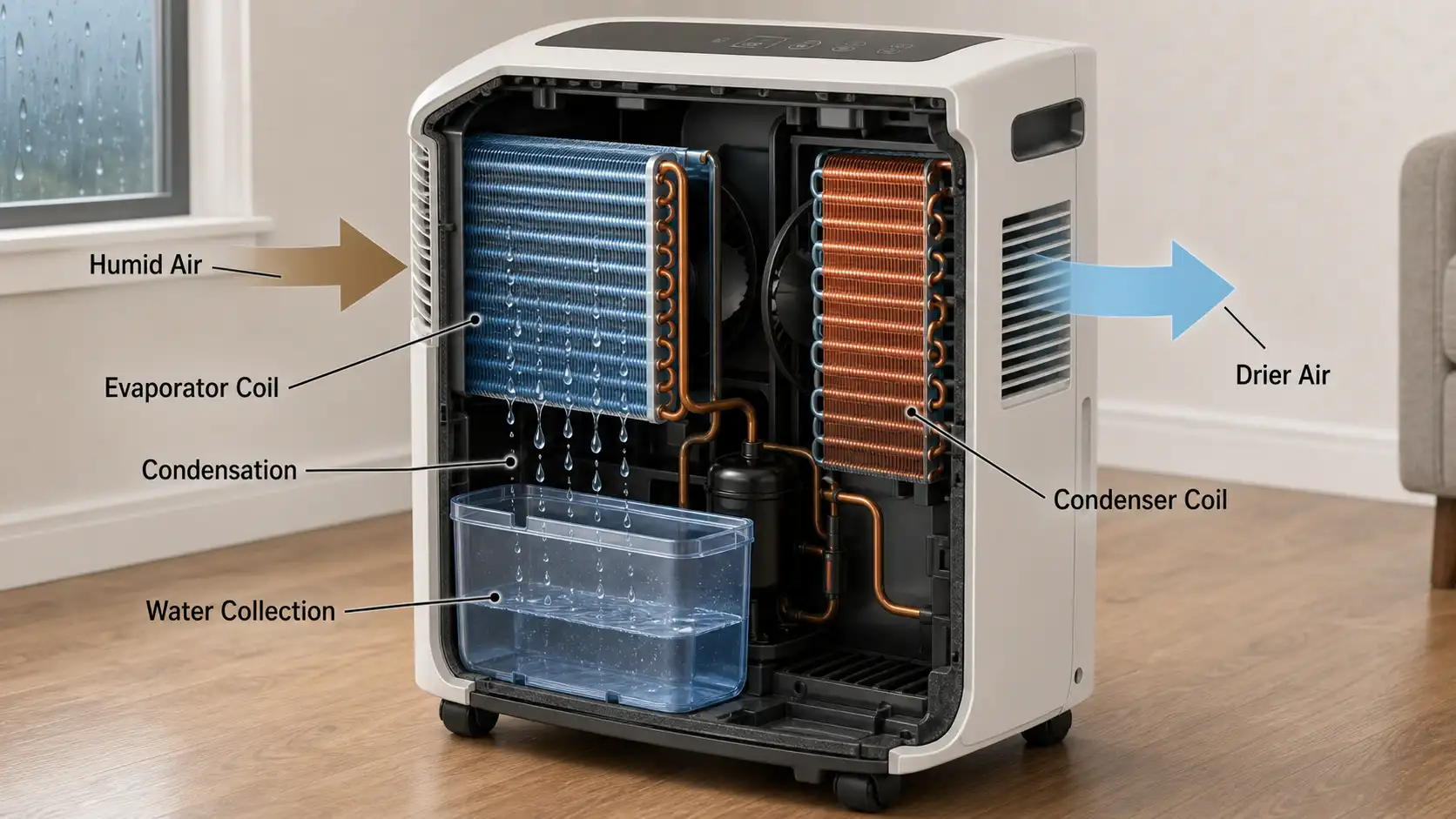
Most portable household units use refrigeration to remove moisture. Some units use desiccant material instead.
Refrigerant Dehumidifiers
A refrigerant dehumidifier works much like a small refrigeration system.
First, a fan pulls humid room air into the unit. The air passes across a cold evaporator coil. Water vapor in the air condenses on that cold surface.
The collected water then flows into a reservoir or through a drain hose. The drier air continues through the unit and passes over a warmer condenser coil before returning to the room.
The basic process is:
Humid air → cold coil → condensation → water removal → warm coil → drier air
The compressor, refrigerant, evaporator coil, and condenser coil work together during this process.
The important point is that moisture removal does not mean heat removal. A dehumidifier removes water from the air while releasing heat back into the space.
Desiccant Dehumidifiers
Desiccant units use a moisture-absorbing material instead of relying on the same compressor-based refrigeration cycle.
The desiccant captures water vapor from passing air. Many systems then use a regeneration process to remove moisture from the desiccant so it can keep working.
Desiccant technology can be useful in cooler spaces and certain applications where refrigerant units are less effective.
However, it is not accurate to assume a desiccant unit never adds heat. The operating design and regeneration process can affect the temperature of the discharged air.
Does a Dehumidifier Make a Room Warmer?
Yes, a refrigerant dehumidifier can make the surrounding air warmer.
This happens for two main reasons.
First, the unit uses electrical energy. That energy eventually becomes heat inside the space.
Second, the refrigeration system moves heat as it removes moisture. The heat collected during the process is released through the condenser side of the system.
ENERGY STAR notes that the air directly around a dehumidifier may be warmer because the unit slightly warms the space as it removes moisture.
The temperature change is not the same in every room. It depends on factors such as:
- Unit wattage
- Room size
- Runtime
- Starting temperature
- Ventilation
- Air leakage
- Moisture load
- Equipment design
A small closed room can show a more noticeable temperature increase than a large, open space.
This creates the main question behind this topic:
Why can a room feel cooler when the appliance is adding heat?
Because air temperature and thermal comfort are different things. Lower humidity can improve sweat evaporation and reduce that sticky feeling. You may feel better even if the thermometer does not fall.
Dehumidifier vs. Air Conditioner vs. Fan: Which Actually Cools a Room?
Different equipment solves different comfort problems.
| Device | Lowers Temperature | Removes Moisture | Main Purpose |
| Dehumidifier | Little or no direct cooling | Yes | Humidity control |
| Air conditioner | Yes | Yes | Cooling and dehumidification |
| Fan | No | No | Air movement and evaporative comfort |
A central AC system removes heat from indoor air and rejects it outside. During normal cooling, moisture also condenses on the cold evaporator coil.
A portable AC can provide actual cooling for one room. A window AC unit can do the same when properly sized and installed.
A ductless mini-split can provide targeted cooling without traditional ductwork. It also removes some moisture during cooling.
A ceiling fan works differently. It does not lower the room temperature. Instead, moving air across your skin can improve sweat evaporation and make you feel cooler.
An evaporative cooler is another different system. It uses water evaporation to cool air and works best in dry climates. It is not a good match for already humid conditions.
The main rule is simple:
If you need the temperature to fall, use cooling equipment. If excess moisture is the problem, use dehumidification.
When Is a Dehumidifier Better Than More Cooling?
A dehumidifier makes sense when the temperature is acceptable but indoor humidity is too high.
It can help when:
- The room feels sticky or muggy.
- Indoor RH stays high.
- The basement feels damp.
- Condensation appears on cool surfaces.
- Musty odors develop.
- Your AC cools the room but does not control moisture well.
Basements and crawl spaces often need moisture control because water can enter through the foundation, soil, leaks, or humid air.
The EPA recommends keeping indoor humidity below 60%, with 30% to 50% being the preferred range.
You need AC when the room is genuinely too hot. A dehumidifier cannot remove the heat entering through direct sunlight or a poorly insulated building.
You may need both systems when a room is hot and humid.
For example, a Houston bedroom may feel uncomfortable because of both high temperature and moisture. Dehumidification can reduce the muggy feeling, but AC is still needed to remove the heat.
Can You Run a Dehumidifier With Your AC?
Yes. In some homes, using both systems can make sense.
Your AC does some dehumidification when it’s cooling. Warm indoor air flows across the cool evaporator coil, and moisture might condense on it.
The issue is when the AC hits the thermostat setting before it has removed enough moisture.
A large AC might make this problem worse. A larger system may cool the space too quickly and turn off before it has operated long enough to remove the moisture required.
Dedicated humidity management with a separate dehumidifier.
A whole-home dehumidifier can be tied into the HVAC system to dehumidify air throughout the household. Whole-home units can be helpful in homes with central air where humidity hovers above 55% continuously, ENERGY STAR says.
The thermostat controls the temperature. Humidity is regulated using a humidistat.
Don’t assume turning up the thermostat will always cut your energy expenditure. The outcome hinges on the equipment’s performance, the humidity load, operating time, external conditions, and the operation of the HVAC system.
Dehumidifier in Summer: How to Use One Effectively
A dehumidifier in summer works best when you use it to control excess moisture rather than chase an extremely low humidity reading.
Start by measuring indoor RH with a humidity gauge. The EPA recommends 30% to 50% RH for indoor spaces when possible.
Then:
- Set a realistic humidity target between 30 and 50 percent, which lines up with guidance from the U.S. Environmental Protection Agency on preventing mold and moisture problems.
- Choose a unit suited to the space and moisture load.
- Keep exterior doors and windows closed while dehumidifying conditioned air.
- Leave enough space around the unit for proper airflow.
- Clean the filter according to the manufacturer’s instructions.
- Empty the water reservoir or use a suitable continuous drain.
- Watch both room temperature and RH.
- Stop the unit from running once the target humidity is reached.
Capacity is usually listed in pints of water removed per day. ENERGY STAR says the right capacity depends on both room size and how damp the space is.
As a real example, ENERGY STAR’s current guidance lists roughly 20 to 30 pints per day for a slightly to moderately damp small-to-medium space, with larger capacity recommended as moisture conditions become more severe.
Energy cost also depends on the unit and runtime. ENERGY STAR uses Integrated Energy Factor, or IEF, to compare dehumidifier efficiency.
For a simple cost example, a 500-watt unit running eight hours daily uses about 4 kWh per day. At the May 2026 Texas residential average of 16.39 cents per kWh, that equals about $0.66 per day, or roughly $19.67 for 30 days if it ran eight hours every day. Your actual bill depends on your electricity rate and the unit’s power draw.
ENERGY STAR also reports that certified dehumidifiers use about 20% less energy than comparable conventional models while removing the same amount of moisture.
How Do You Know Whether You Need Cooling or Dehumidification?
Use the room’s temperature and humidity together.
- Hot + humid:
You need actual cooling plus moisture control. - Comfortable temperature + humid:
A dehumidifier may solve the main comfort problem. - Hot + relatively dry:
Focus on cooling, shading, insulation, and airflow. - AC runs but RH stays high:
Look for HVAC performance problems, moisture sources, airflow issues, duct leakage, or poor system sizing.
Do not treat the dehumidifier as a fix for every hot-room problem.
If sunlight heats the room, reducing humidity will not remove that heat. If outdoor air enters through leaks, it can also keep bringing moisture indoors.
When high humidity continues despite normal AC operation, an HVAC professional can check the system and moisture load.
For Houston homeowners, dehumidifier installation services in Houston can be useful when a home needs dedicated moisture control beyond what the existing AC system provides.
If your home stays humid even when the AC is running, contact 75 Degree AC for an evaluation and a practical dehumidification solution.
The Bottom Line
A dehumidifier does not produce the actual temperature drop of an air conditioner. It pulls away excess moisture, which can help sweat evaporate and make a humid area feel more comfortable.
If the temperature is right but the humidity is high, dehumidification may be all that’s needed. Real cooling and moisture management are needed if it’s hot and humid.
The easiest guideline is: AC eliminates heat, a dehumidifier removes moisture, and comfort is a function of both.
Frequently Asked Questions
Does a dehumidifier cool the room without AC?
It can reduce humidity without AC, but it is not a replacement for cooling. If the room is genuinely hot, you still need a cooling system.
Does a dehumidifier make a room hotter?
A refrigerant unit can add heat while operating. The effect depends on its power use, runtime, room size, and ventilation.
Should I run a dehumidifier with my AC?
You can when the AC controls temperature but indoor humidity remains high. A separate unit may not be needed when the HVAC system already keeps RH under control.
Is a dehumidifier good for summer?
Yes, when summer moisture is the main comfort problem. It is especially useful in damp rooms, basements, and homes where humidity stays high.
What humidity level is comfortable indoors?
The EPA recommends keeping indoor humidity between 30% and 50% when possible. It also advises keeping indoor RH below 60% to help control moisture-related problems.
Is a fan or dehumidifier better for cooling?
A fan improves air movement and can help sweat evaporate. A dehumidifier removes moisture. Neither replaces an air conditioner for actual temperature reduction.
Can a dehumidifier replace an air conditioner?
No. A dehumidifier controls moisture, while an air conditioner removes heat and also provides some dehumidification during cooling.
Why does my room still feel hot after using a dehumidifier?
The room may have too much actual heat. Check the AC, insulation, windows, solar gain, airflow, and indoor temperature. Lower humidity alone cannot remove heat from the room.

