
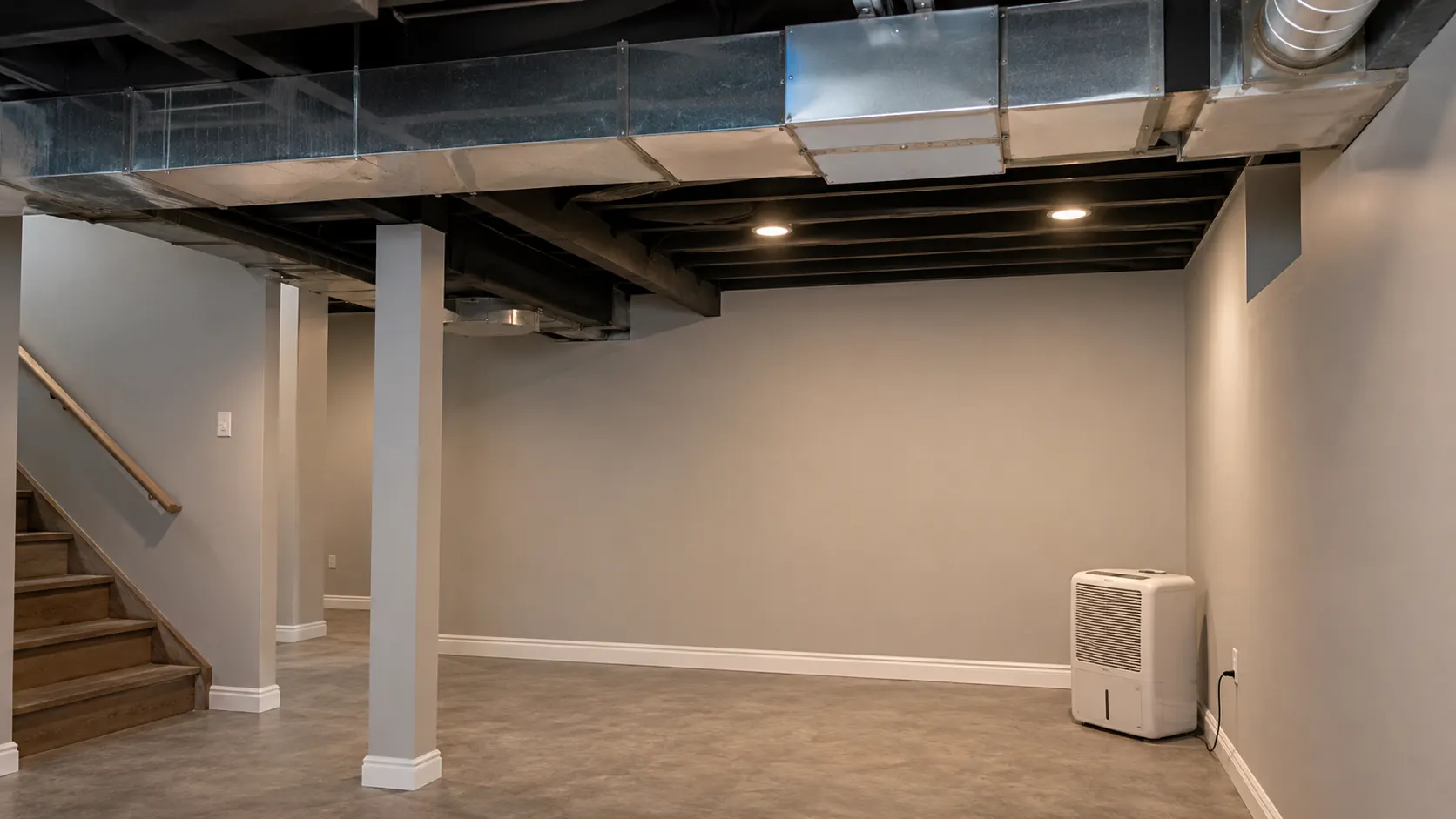
A windless basement would be stuffy, damp, and uncomfortable as it lacks natural ventilation. Poor airflow contributes to moisture, odors, and stale air marring a room for too long. Fortunately, improved ventilation does not require windows. With good ventilation equipment and moisture management, you can make a basement without windows the breath of fresh air it should be.
Here’s how to ventilate a basement without windows, be it mechanical ventilation, exhaust fans, airflow, or dehumidifiers. It goes into the difference between dehumidification Vs ventilation of a basement, and you can find realistic suggestions to help you keep basement air that is healthier.
Why Does a Windowless Basement Need Ventilation

The fact that basements are enveloped by soil and usually have cooler surfaces contributes to basements running humid. This warm, moist air can condense on cool surfaces like walls, floors, pipes, and other surfaces when the air comes into contact with it in the basement.
A poorly drained basement can become:
- Musty or stale odors
- Raised humidity levels
- Condensation
- Mold and Mildew Development
- Lack of fresh air
- Stale indoor air
- High potential for water damage.
- Humidified air
- High potential for moisture damage.
Adequate basement ventilation without a window will allow for stale indoor air to be blown out and a breath of fresh air to be blown in.
Set Up a Mechanical Ventilation System
For air exchange, mechanical ventilation is one of the best options. Mechanical ventilation systems have fans that force air through ductwork, unlike natural ventilation. A simple system could have a single exhaust fan that draws stale basement air out, and the replacement air comes in through an intake duct.
Two-way (or balanced) air exchange is often recommended for the larger and/or busier basements. Heat recovery ventilators (HRVs) and energy recovery ventilators (ERVs) can equalize inside and outside air with less energy loss.
An experienced, informed air conditioning repair technician will be able to tell you what is best for your specific situation, based on your basement size and configuration, the humidity level in your region, and what kind of system you currently have.
Use an Exhaust Fan
An exhaust fan is another practical option for improving basement airflow. The fan should be vented to the outdoors through a properly installed duct. The intention is to extract stale, moist air, not to just spread it within the basement.
When installing an exhaust fan, be sure: The fan should be the right size for the room. Exhaust air to the outside instead of recirculation the air. The ductwork is sealed well. The outdoor Vents are designed to prevent rain, insects, and debris from getting inside.
A licensed HVAC contractor will be performing or supervising the work. Never vent warm, moist basement air into an attic, crawl space, wall cavity, or other indoor space.
Add a Fresh-Air Intake

A dedicated fresh-air intake offers a controlled feed to outside air. In some homes, this may be part of a mechanical ventilation system. Fresh air systems must be properly designed because when you bring outside air into a basement, you can also bring in moisture. In humid climates, bringing in raw outdoor air will compound the moisture problems.
Use a Dehumidifier
While a dehumidifier doesn’t really ventilate the basement, it does help manage moisture levels.
A dehumidifier is especially useful when:
- Basement condensation
- There is a musty smell in the air
- The basement is located underground
You’re adding more moisture to the air if you open windows to ventilate. Because many basements have no windows, the best results are attained by using controlled ventilation and dehumidification together, rather than relying on one method.
Boost the Airflow with Fans
If you have good ventilation in the basement already but some spots feel like they could use a little freshening, bring some fans in.
Fans (portable fans, ceiling fans, or HVAC circulation fans) will help to circulate the air in a basement by blowing it around in different areas of the room.
But keep in mind: even a circulation fan won’t remove moisture or stale air on its own. It just circulates the air that is already there.
For more on how to increase air circulation in a basement, take note: When putting fans to work, do try to move air through a room, or through a corner, or through an enclosed space, instead of just aiming them at a wall.
Keep HVAC Air Flowing
If your basement is part of your home’s central HVAC, check that your supply and return vents are open.
Blocked or closed vents reduce airflow. Keep doors open if and when it is appropriate for air to travel between you and the next connected room.
In some HVAC systems, you can run the fan nonstop so as to keep the air moving/ circulating without having the heat or AC going. Check with an HVAC professional 75 Degree AC whether this is a good option for your system.
Caulk Those Leaks
If water is continuously entering a basement, it cannot be ventilated away.
Check for:
- Plumbing leaks,
- Foundation cracks
- Leaking pipes
- Poor drainage around the foundation,
- Condensation on cold pipes,
- Water in at the Utility Penetration
Remove the source of moisture, and moisture intrusion should get better. “Source: the typical answer from a Minneapolis expert. Having source-control Control the sources of moisture in the home, such as leaking pipes or roof and basement foundations cracks, and you will have a drier basement. Remove moisture sources as part of your overall basement ventilation strategy.
If the water is entering through the walls or slab, you may have to have it waterproofed professionally.
Keep Basement Doors and Walls Clear of Obstructions
Furniture, boxes, and other things can block the airflow. Large items should not be stored up against windows or exterior basement walls, as this blocks air circulation and contributes to moisture problems.
Allow for adequate space around walls and vents of HVAC. Maintain airflow. Be sure to keep some airflow between rooms if you can.
This easy method can go a long way in tips on how to increase air circulation in a basement.
Humidity Level Watching
A tiny digital hygrometer is a handy little tool that will let you keep an eye on basement humidity. The accepted levels of indoor relative humidity are on the order of 30%-50%, but the best level can depend on the climate and the building. If the moisture remains too high, investigate; don’t just increase fan action.
A dehumidifier equipped with a humidistat can be set to automatically start operation when humidity increases beyond a certain level, and to stop when the air is clean enough.
Basement Dehumidifier Vs Ventilation – The Better Solution?

Whether to use ventilation or dehumidification depends on the source of your problem.
Ventilation is appropriate if the major problem is stale indoor air and the outdoor air is good enough to be let indoors. If the problem is high humidity in the air, then dehumidifying will help, especially if you’re letting humid outside air in.
Mechanical ventilation introduces a fresh-air supply, and the dehumidifier takes the moisture out.
You can’t just open up a window, put in a duct, and fix things; know that the outdoor air is also bringing moisture loads with it during the hot and humid months. Dehumidification is the answer if the problem is too much moisture in the air, specifically if the air you’re bringing in from the outside is already moist.
Read more How to Test Indoor Air Quality
How Can You Ventilate a Basement Without a Window?
Which windowless basement ventilation option is best for you depends partly on the size and use of the space, how damp it is, and what type of HVAC system you have.
A separate mechanical ventilation system may be more practical for a large finished basement. When humidity is a lingering issue, a properly sized dehumidifier can significantly improve the comfort level of the room.
If you have questions about airflow, duct size, electricity needs, or moisture sources, call a professional to come look in your basement.
Common Errors to Avoid
Avoid these basement ventilation mistakes when you don’t have windows:
1: Relying solely on a Circulation Fan
A fan can circulate air but it cannot remove stale air in the structure or reduce moisture on its own.
2: Discharging Air into a Different Indoor Area
Don’t vent humid basement air into an attic, wall cavity or crawlspace, or any other enclosed space.
3: Ignoring Humidity
If excess moisture is the primary issue, following it up with ventilation alone is probably not going to work. You may require a dehumidifier and repairs to the source of moisture.
4: Bringing in Too Much Humid Outdoor Air
During hot and humid weather, basement humidity may be exacerbated by bringing in unregulated outdoor air.
5: Blocking HVAC Vents
Furniture and stored items can block airflow and prevent proper air circulation.
Concluding Remarks
How to ventilate a basement without windows begins with determining if your primary concern is stale air, lack of airflow, high humidity, or water penetration from the outside. Mechanical ventilation systems exhaust fans, fresh air intakes, circulation fans, and dehumidifiers are useful.
Controlled air exchange is the real secret to successful basement ventilation without windows or vents. If humidity is too high, use ventilation with moisture control as needed. Monitor humidity, check for leaks, and keep airflow corridors open regularly.
If your basement is consistently damp, mold-ridden, or unhealthy to breathe in, you may contact us have an HVAC or building professional take a look at the area and suggest a well-designed ventilation option.
FAQs
How can I vent a basement that has no windows?
Mechanical ventilation can be employed with a properly installed exhaust fan or an HRV/ERV unit for the air exchange between indoors and outdoors. Dehumidifiers can help with the moisture, but they don’t actually ventilate with fresh air.
How do you circulate air in a basement with no windows?
Ventilating a windowless basement will be different according to its size and condition. A mechanical system with fresh-air intake and exhaust ductwork may be the most suitable option. If there is high humidity, a dehumidifier can be added.
For a basement, is ventilation or a dehumidifier better?
One is to ventilate, the other is to dehumidify, and their functions don’t ever truly overlap. Ventilation replaces the indoor air; a dehumidifier extracts the moisture. If you have a humid and stuffy basement, you should get better results from both of them.
How do I get better airflow in my basement?
To enhance the circulation, leave your HVAC vents open, don’t block the flow of air with large pieces of furniture or boxes, utilize fans to help air flow, and possibly add mechanical ventilation. When it comes to how to improve air circulation in a basement, keep in mind that air circulation itself is not a high-humidity cure.
Can you use an exhaust fan to get rid of moisture from the basement?
An exhaust fan can remove a certain amount of moisture-laden indoor air, but how much depends on outdoor conditions and the source of the moisture. In humid conditions, ventilating with outdoor air may result in bringing in moisture. You can have more direct control over humidity with a dehumidifier.

