
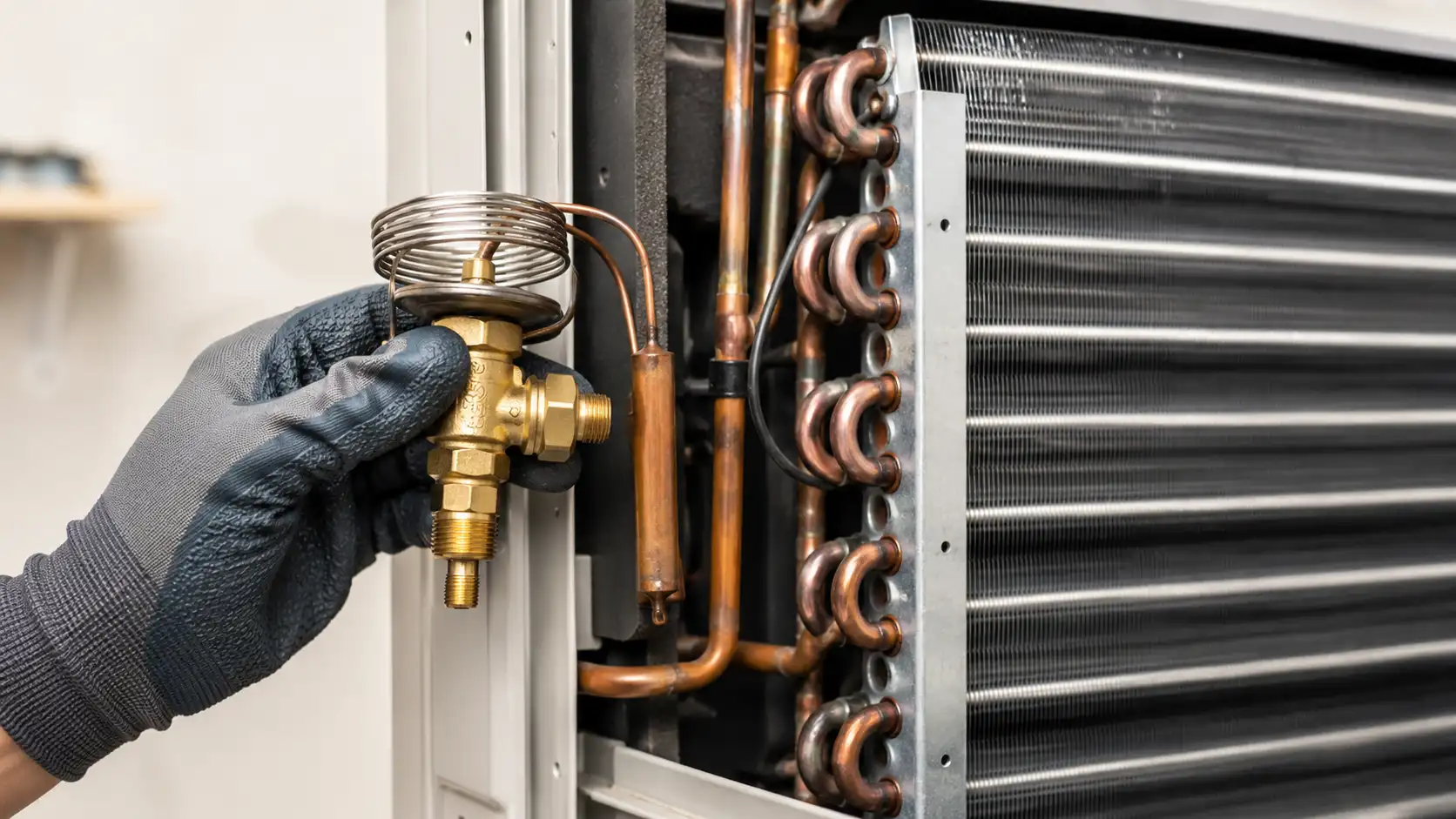
If you’ve ever asked yourself, What is a TXV in HVAC? you aren’t the only one. The thermostatic expansion valve, abbreviated TXV, is a small but crucial part of many AC and heat pump systems. Its job is to control how much refrigerant enters the evaporator coil in order to optimize system efficiency and keep the compressor safe.
When a TXV malfunctions, it can cause troubling issues with your cooling performance such as lack of air conditioning, temperature fluctuations, reduced suction pressure, or a frozen evaporator coil. These issues can also be signs of other HVAC problems, so it’s important to have the valve properly tested before replacing it.
What Is a TXV in HVAC?
TXV stands for Thermostatic Expansion Valve. It is a refrigerant metering device located right beside the evaporator coil.
A TXV controls how much liquid refrigerant reaches the evaporator based on the temperature and pressure of the refrigerant leaving the evaporator. It also helps maintain the proper superheat level so that liquid refrigerant does not return to the compressor.
Read more What is a VAV in HVAC
What Does a TXV Do?
Think of a TXV as a controlled gate. It doesn’t allow a constant volume of refrigerant regardless of conditions; instead, it adjusts flow based on the system’s cooling demand.
A TXV does the following:
- Controls refrigerant flow to the evaporator
- Keeps superheat at the correct level
- Responds to changing cooling demand
- Allows the evaporator to work efficiently
- Prevents liquid refrigerant from entering the compressor
Because the valve constantly adjusts to system conditions, it can supply more precisely regulated refrigerant than a fixed metering device could.
How Does a TXV Work?
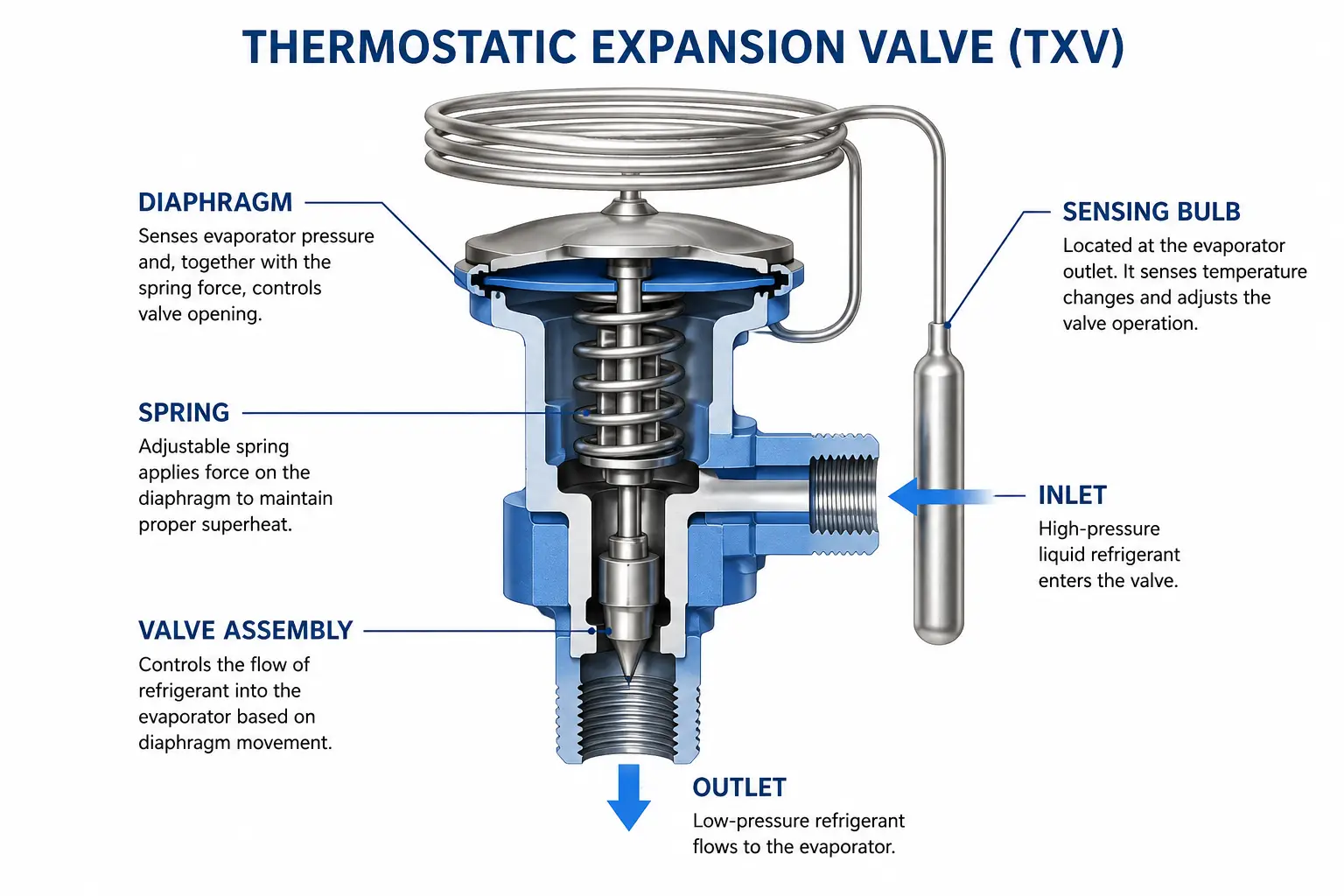
A conventional TXV uses a sensing bulb, diaphragm, spring, and valve assembly that “throttles” the flow of refrigerant from one part of the system to the next. A sensing bulb, connected directly to the outlet of the evaporator coil, detects the temperature of the discharged refrigerant.
A temperature change at the outlet sensing bulb causes the diaphragm to expand or contract, which in turn opens or closes the valve.
The valve opening increases as cooling demand increases and closes as demand decreases. This automatic adjustment is the main reason TXVs are used in most modern air conditioning equipment.
Why Is a TXV Important?
For the coil to absorb heat efficiently, it needs the right amount of refrigerant entering the evaporator coil.
If there is too little refrigerant, some sections of the coil may not receive any at all. If there is too much, refrigerant may not fully evaporate before reaching the compressor.
A properly functioning TXV balances these conditions to achieve maximum cooling while protecting the compressor. In other words, a failing TXV can affect far more than just how cool your home feels.
Thermostatic Expansion Valve Symptoms
Knowing the typical thermostatic expansion valve symptoms can help you recognize when your AC needs professional attention.
- Poor or Inconsistent Cooling If the AC powers on but doesn’t cool your home, a faulty TXV could be to blame. When the expansion valve isn’t working correctly, it won’t let the right volume of refrigerant flow into the evaporator. Keep in mind that other issues like clogged air filters or blocked registers can cause similar symptoms.
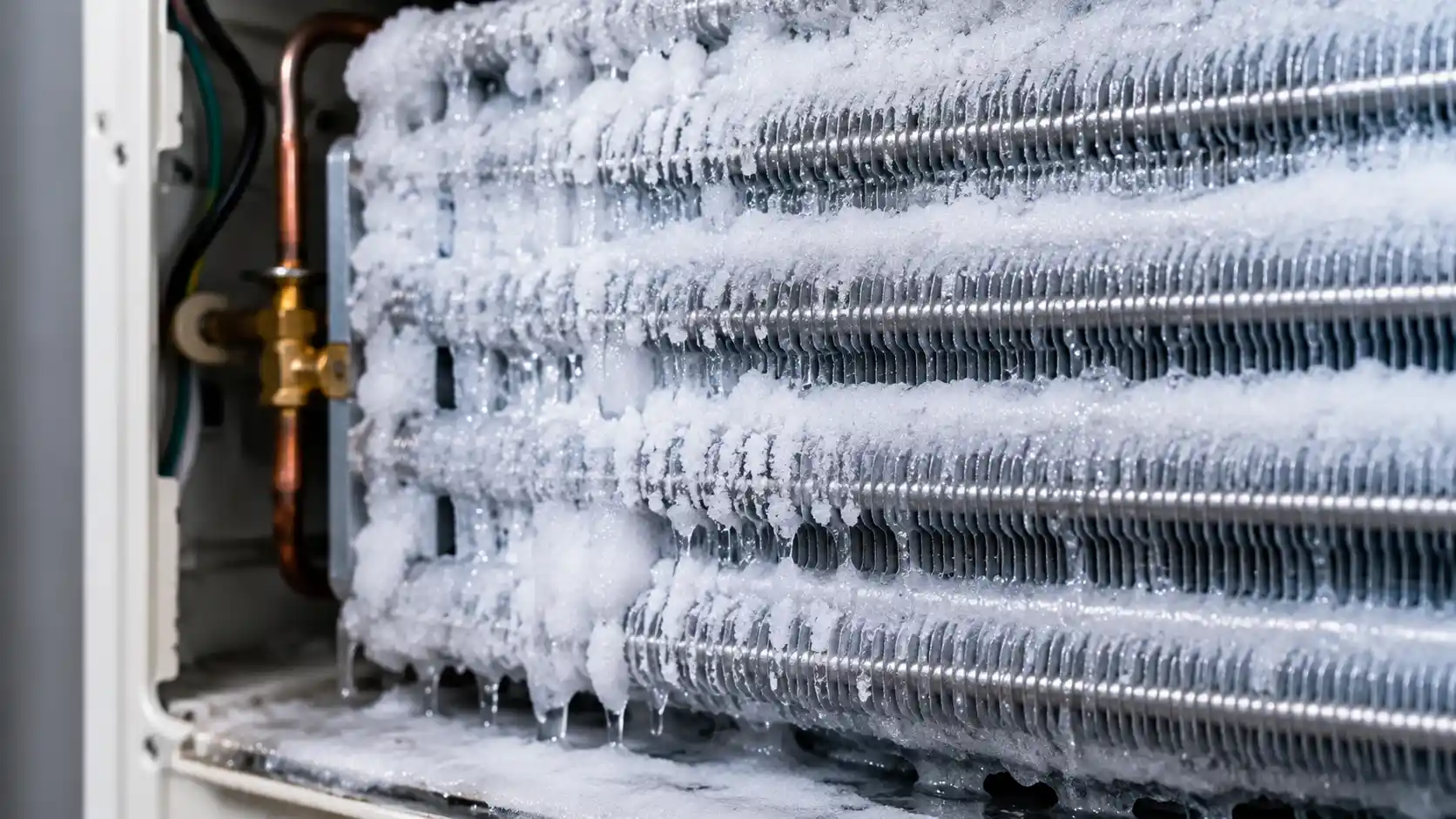
- Frozen Evaporator Coil Restrictions or other problems within a faulty TXV can reduce refrigerant flow, creating unusually cold conditions. This can result in frost or ice buildup on the evaporator coil or suction line. This doesn’t automatically mean the TXV is the culprit it could also be an airflow issue or low refrigerant levels.
- Low Suction Pressure When troubleshooting a restriction in the TXV or another flow issue, a technician will often find abnormally low suction pressure. However, pressure gauge readings must be evaluated alongside superheat, sub cooling, temperatures, airflow, and system specifications.
- Fluctuating Temperatures If the air from your vents alternates between cool and warm, it may point to a refrigerant metering problem. A faulty metering valve can play a direct role in unsteady temperatures.
- Reduced Cooling Capacity A restricted or failing TXV prevents the evaporator from receiving proper refrigerant flow, which can result in insufficient cooling.
TXV vs. Fixed Orifice: What’s the Difference?
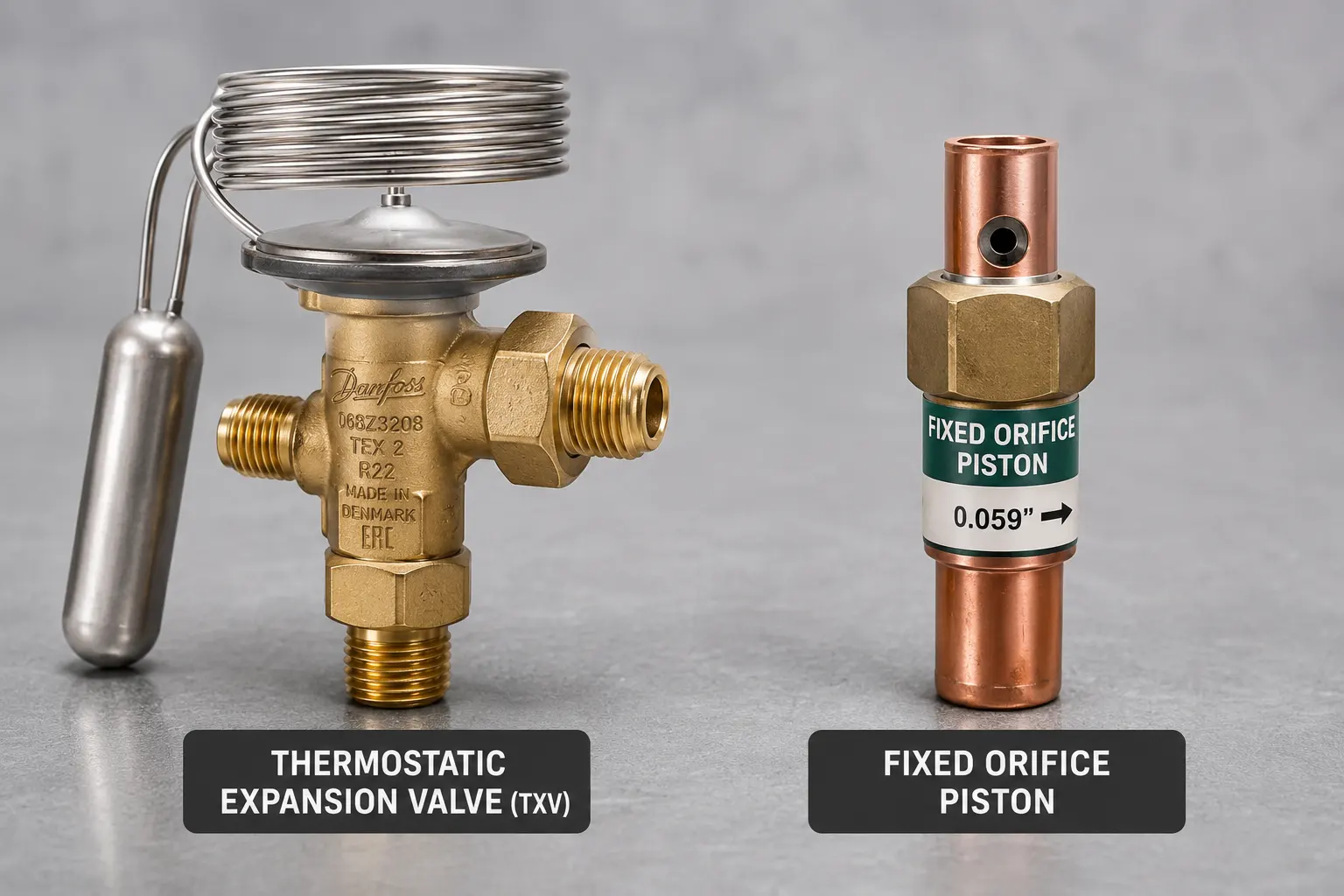
Understanding TXV vs. fixed orifice systems is useful when comparing different AC designs.
A TXV actively adjusts refrigerant flow based on operating conditions. A fixed orifice, by comparison, has a predetermined opening size and does not actively adjust in response to changing cooling loads.
| Feature | TXV | Fixed Orifice |
| Refrigerant control | Adjustable | Fixed |
| Responds to changing load | Yes | No |
| Controls superheat | Actively regulated | Determined by system conditions |
| Complexity | More complex | Simpler |
| Maintenance | Requires proper diagnosis | Generally simpler |
| Performance | Precise refrigerant metering | Less adaptive |
Neither design is automatically the right choice for every system. The appropriate metering device depends on equipment design and manufacturer specifications.
Common TXV Problems
Several issues can interfere with TXV operation.
Restricted TXV
Debris or contamination can restrict refrigerant flow through the valve, causing the evaporator to become starved of refrigerant.
TXV Stuck Closed
If the valve doesn’t open properly, refrigerant flow becomes severely restricted, which can lead to poor cooling and abnormal pressure readings.
TXV Stuck Open
When the TXV allows too much refrigerant into the evaporator, the coil can become overfed. This often results in low superheat and can allow liquid refrigerant to carry through the system.
Incorrect Sensing Bulb Installation
The sensing bulb is critical to TXV operation. How it’s attached and positioned relative to the coil can directly impact both system performance and TXV function.
Contamination or Moisture
Contamination or moisture anywhere in the system will almost always cause problems. For this reason, refrigerant-side repairs should always be performed according to local, state, and national guidelines using proper HVAC repair equipment.
Expansion Valve HVAC Troubleshooting
When diagnosing an expansion valve issue, it isn’t enough to simply look at the valve itself. A professional technician will typically examine:
- Airflow – A dirty filter or blocked duct can produce symptoms that resemble refrigerant problems.
- Refrigerant charge – Incorrect refrigerant charge can affect pressures and cooling performance.
- Superheat and sub cooling – These readings show how the refrigeration system is operating.
- Suction and liquid pressures – These also help reveal how the system is performing.
- Sensing bulb installation – Incorrect placement can cause misleading readings and point to false restrictions.
- Evaporator and condenser condition – The technician should confirm the sensing bulb is secured and properly installed. Dirt or debris on either coil’s fins can affect overall system efficiency.
- Refrigerant restrictions – The technician should inspect the entire system for restrictions before attributing the issue to a failing TXV.
It would be unwise to diagnose a TXV failure based on symptoms alone.
Read more What does SEER mean in HVAC
How Much Does TXV Replacement Cost?
The cost of replacing a TXV can vary widely depending on the system, installation accessibility, region, refrigerant type, and labor. In general, residential replacement can range from $250–$950, and jobs requiring access behind panels or use of a ladder can run $500–$1,000.
Other reported estimates range from $350–$450, $500–$700, and $400–$700. The final price often comes down to a few hundred dollars on average, depending on your specific situation.
Factors That Affect TXV Replacement Cost
- HVAC system type and size
- Cost of the replacement part
- Accessibility of the evaporator coil
- Labor fees in your area
- Recovery and recharge of refrigerant
- Leak testing
- Filter-drier replacement
- Any additional services required
Valves in easily accessible locations are typically less expensive to replace than those in hard-to-reach areas.
It’s always best to get a written estimate from your service technician after the cause of the problem has been diagnosed, since prices can vary based on your specific situation.
Should You Replace the TXV or the AC System?
A broken TXV doesn’t necessarily mean you need to replace your entire AC system.
If the rest of your system is in good working condition and the valve repair is relatively inexpensive, replacement is often the cost-effective choice. However, if you have an older system with multiple issues, or an aging evaporator coil, it may be worth weighing the repair cost against the cost of a full system replacement.
Ask a professional to assess:
- Age of the AC system
- Condition of the entire system (including the condenser and evaporator coils)
- AC repair history
- Type of refrigerant used
- Energy efficiency of your current system
- Availability of a replacement part
- The actual cost of repairing the TXV
- The overall cost of installing a new air conditioning system
Don’t let a fully functional AC system get replaced over a suspected TXV issue — make sure the system’s diagnostic readings confirm the valve as the actual source of the problem.
When Should You Call an HVAC Professional?
Checking or replacing a TXV involves working within a sealed refrigerant system. Any work involving refrigerant recovery, brazing, evacuation, and charging requires specialized tools and training.
Call an HVAC professional if your AC is:
- Not providing enough cooling
- Repeatedly developing a frozen evaporator coil
- Not operating within correct refrigerant pressures
- Running constantly without adequate cooling
- Producing inconsistent supply air temperatures
- Diagnosed by a technician as possibly restricted
Important: Do not attempt to adjust or replace your TXV yourself unless you are properly trained to work with refrigeration systems and have the appropriate equipment.
Final Thoughts
So, what is a TXV in HVAC? It’s a thermostatic expansion valve that regulates refrigerant as it enters the evaporator, adjusting automatically to system conditions. It plays a key role in maintaining proper refrigerant flow and overall AC efficiency.
Understanding common TXV symptoms, the difference between TXV and fixed orifice systems, and the basics of expansion valve troubleshooting can help you recognize when your TXV might be the cause of a system issue. That said, symptoms alone can’t confirm a diagnosis.
Before paying for a TXV replacement, have your system examined by an HVAC professional. If you’re looking for a skilled HVAC technician in your area, 75 Degree AC can accurately diagnose your system’s issue and repair it appropriately.
FAQs
What does TXV stand for in HVAC?
TXV stands for Thermostatic Expansion Valve. It’s a refrigerant metering device located near the evaporator coil that controls how much refrigerant flows into the system.
What are the signs of a bad TXV?
Common signs include poor or inconsistent cooling, a frozen evaporator coil, low suction pressure, fluctuating supply air temperatures, and reduced overall cooling capacity. These symptoms can also point to other HVAC issues, so proper diagnosis is important.
Can a TXV cause a frozen evaporator coil?
Yes. A restricted or malfunctioning TXV can reduce refrigerant flow enough to cause frost or ice buildup on the evaporator coil or suction line. However, low refrigerant charge and airflow problems can cause the same issue, so a technician should confirm the actual cause.
What’s the difference between a TXV and a fixed orifice?
A TXV actively adjusts refrigerant flow based on changing system conditions, while a fixed orifice has a set opening size that doesn’t adjust. TXVs generally offer more precise refrigerant metering, while fixed orifice systems are simpler and require less maintenance.
How much does it cost to replace a TXV?
Replacement typically costs between $250 and $950 for standard residential installations, and up to $1,000 if the evaporator coil is hard to access. Exact pricing depends on your system type, region, and labor costs, so it’s best to get a written estimate from a technician.
Can I replace a TXV myself? No. TXV replacement involves working inside a sealed refrigerant system, including refrigerant recovery, brazing, evacuation, and recharging. This requires specialized tools, EPA certification, and training, so it should only be done by a licensed HVAC professional.
Do I need to replace my whole AC system if the TXV fails?
Not necessarily. If the rest of your system is in good condition, replacing just the TXV is often the more cost-effective option. A full system replacement is usually only worth considering if your AC is older or has multiple other issues.
How do I know if it’s really the TXV and not something else?
A technician will check airflow, refrigerant charge, superheat and sub cooling, suction and liquid pressures, and sensing bulb installation before confirming a TXV failure. Symptoms alone aren’t enough to diagnose the valve as the cause.