
- Licensed TACLA72152E
- 77429, 77433 and 77410
HVAC Repair in Cypress, TX Both Sides of the System, One Call
- Heating and Cooling, One License
- Parts for Both Sides on the Truck
- Readings Shown Before a Quote





HVAC Repair Across Cypress, 77429, 77433 and 77410
75 Degree AC repairs both halves of the HVAC system across Cypress, Texas, covering ZIP codes 77429, 77433 and 77410 in unincorporated Harris County. 75 Degree AC works both sides under a single Texas Class A license, TACLA72152E, which carries no tonnage ceiling, and has run out of Houston since 2016. The two halves of a Cypress system do very unequal amounts of work. The cooling side runs on the order of 3,200 hours a year here. The heating side runs closer to 500. That gap is why they fail for different reasons: the air conditioner wears out, and the furnace seizes up from sitting still. The most common furnace failure is a cracked hot surface ignitor, generally $150 to $400 installed. Trucks carry parts for both sides. Call (713) 598-2737.
75 Degree AC repairs heating and cooling equipment across all three Cypress ZIP codes, plus Jersey Village, Spring and the Huffmeister corridor. Trucks run north-west up US-290 from the shop on West 34th Street. Cypress has no city government of its own, which occasionally matters for paperwork and never matters for whether we come out.
What is actually installed here shapes what we get called about. Most of Cy-Fair runs a gas furnace paired with a split-system air conditioner, sharing one cabinet in the attic, one duct network and one thermostat. Newer sections lean more on heat pumps and dual-fuel setups. Either way it is one machine on your bill and two machines in the attic, and they age at completely different rates.
Which half we get called about tracks with which part of Cypress you are in. The older stock east of the Grand Parkway runs mostly gas furnaces. Plenty of those houses are on their second air conditioner and their first furnace, because out here the furnace outlasts the AC by roughly a decade, for reasons the next section gets into. West of the Parkway is newer and carries more heat pumps. That changes the failure list completely. A heat pump has no ignitor and no flame sensor; it fails at the reversing valve, the defrost board, or the outdoor sensor.
Worth saying plainly, because it decides who you should call: a gas furnace and a heat pump are different machines with different faults, and a company that only really does air conditioning will diagnose both of them as an air conditioner.
If you came here about car air conditioning, that is a different trade and not one of ours.
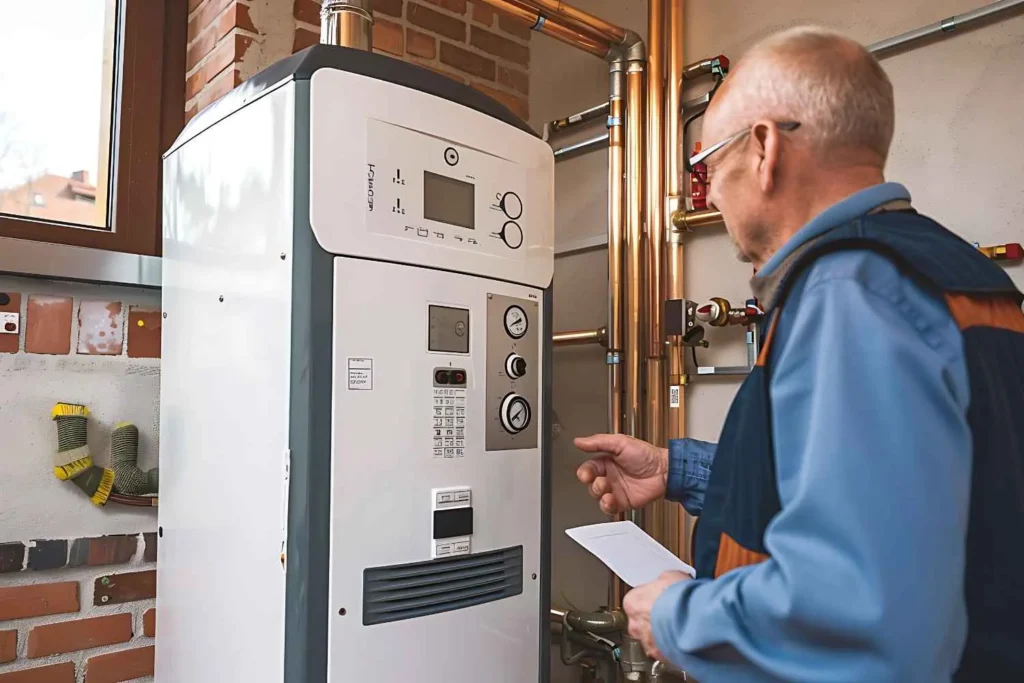
Your AC Runs About 3,200 Hours a Year in Cypress. Your Furnace Runs About 500.
That ratio is the single most useful thing to understand about a Cypress system, and no page on this search result says it. The cooling side works most of the year. The heating side sits still most of the year. Machines that work wear out. Machines that sit seize up. They are not the same problem and they do not get fixed the same way.
For scale, here is the primary number. NOAA’s Climate Prediction Center recorded 2,710 cooling degree days at Houston Intercontinental between 1 January and 22 August 2026, which is 670 above normal, or 33 percent. Heating degree days accumulated since 1 July 2026: zero. Those are dated figures and they will move; the shape of them will not.
| Cooling side | Heating side | |
|---|---|---|
| Roughly how many hours a year it runs here | about 3,200 | about 500 |
| What it dies of | wear. Capacitors, contactors, compressors, coil corrosion | sitting still. Cracked ignitors, fouled flame sensors, seized inducer bearings |
| When it fails | mid-run, usually in August | at start-up, usually on the first cold night |
| Typical repair band | $150 to $2,500, depending on the part | $150 to $600 for the common failures |
| What a tune-up actually prevents | gradual capacity loss you would not otherwise notice | a no-start you would not otherwise see coming |
The runtime hours are trade estimates rather than measured figures, so treat them as roughly right rather than precise. The ratio holds either way, and the ratio is the point. One consequence worth drawing out: a spring air conditioning tune-up does nothing for the heating side, because nobody fires the furnace in April to check it. Most Cypress homes get one half of the system looked at once a year and the other half never.
The Failures That Only Show Up on the First Cold Night
Here is what actually goes wrong when a Cypress furnace has been idle since March. None of it is dramatic and most of it is cheap, which is worth knowing before somebody quotes you a system.
| Part | What you notice | Why it happens | Typical cost, installed |
|---|---|---|---|
| Hot surface ignitor | It tries, you hear a click, no heat | A ceramic element that cracks from heating and cooling cycles, usually at three to seven years | $150 to $400, national average around $175 |
| Flame sensor | Lights, runs a few seconds, shuts down. Repeats | Carbon builds on the sensor rod until it can no longer confirm a flame | Clean $75 to $150, replace $150 to $250 |
| Inducer motor | Grinding or a whine before ignition | Bearings that have not turned in ten months | Varies by model |
| Condensate trap and flue | Short cycling, or a lockout code | Debris and nesting in equipment that sat all summer | Usually labor only |
| Thermostat changeover | Blows, but cold | Not a failure at all. The system never switched modes | No repair needed |
Those costs are published national ranges rather than a 75 Degree AC price list, and your written estimate is the number that counts. The hot surface ignitor is the one worth memorising. It is reported as the single most common furnace repair, it is cheap, and it produces exactly the symptom that makes people fear the worst: a system that clearly has power, clearly tries, and clearly does nothing. Zero of the eleven Cypress pages we measured on this search name it. Ten of them use the word furnace. 75 Degree AC diagnoses the heating side with a meter on the ignitor and a flame-rectification reading off the sensor, and shows you both before quoting anything. The order matters as much as the readings. Ignitor and flame sensor first, because they are the cheapest and the most likely. Then the pressure switch and inducer, because a furnace that will not prove draft looks identical from the hallway to one with an ignition fault. Gas valve and control board after that. Heat exchanger last, and only with a combustion analyzer, because that is the finding that ends the conversation about repair. Work the list in the other direction and a diagnosis quietly turns into a sales call.
“What Are the Most Common HVAC Repairs?”
Ranked by what we actually open up, and split by which half of the system it belongs to. The cooling side dominates the count because it does six times the work.
| Rank | Repair | Side | Typical band |
|---|---|---|---|
| 1 | Run capacitor | cooling | $150 to $320 |
| 2 | Hot surface ignitor | heating | $150 to $400 |
| 3 | Contactor | cooling | $150 to $300 |
| 4 | Flame sensor clean or replace | heating | $75 to $250 |
| 5 | Condensate blockage and float switch | shared | labor, usually |
| 6 | Condenser fan motor | cooling | $400 to $700 |
| 7 | Refrigerant leak, found and repaired | cooling | varies widely |
| 8 | Inducer motor | heating | varies by model |
| 9 | Compressor | cooling | $1,800 to $2,500 |
| 10 | Heat exchanger | heating | replacement territory |
Two things fall out of that list. The top four are all inexpensive, and two of the top four are on the heating side. If your first quote skips straight to the bottom of the table, ask what was measured to rule out the top of it.
Why Whole-System Repair Calls Spike in February, Not August
Every other search term in Cypress peaks in the summer. This one does the opposite. Searches for HVAC repair near me, made from inside Cypress, run about 140 in January and 170 in February against 30 in July. It is the only inverted term in the whole Cypress set, and it is also the only one carrying real advertiser money.
The reason is not mysterious. A furnace that has not run since March gets asked to work on the first genuinely cold night of the year, along with every other furnace in Cy-Fair, and the ones with a cracked ignitor all find out within about forty-eight hours of each other. That is why the phones go from quiet to queued in two days.
The practical version: test the heat on a mild day. Set it to heat, push the setpoint up five degrees, and let it run fifteen minutes. You are checking for three things. It lights. It stays lit. Nothing smells like burning dust for more than a minute or two. If any of those fails in October you have a scheduling problem. If it fails in January you have a scheduling problem and a cold house.
There is a supply-chain version of the same argument. Ignitors and flame sensors are stocked parts and we carry them, but model-specific control boards and inducer assemblies are not, and a part that ships in two days in October ships in a week during a cold snap when every distributor in the metro is drawing on the same shelf. The failure is identical. The wait is not.
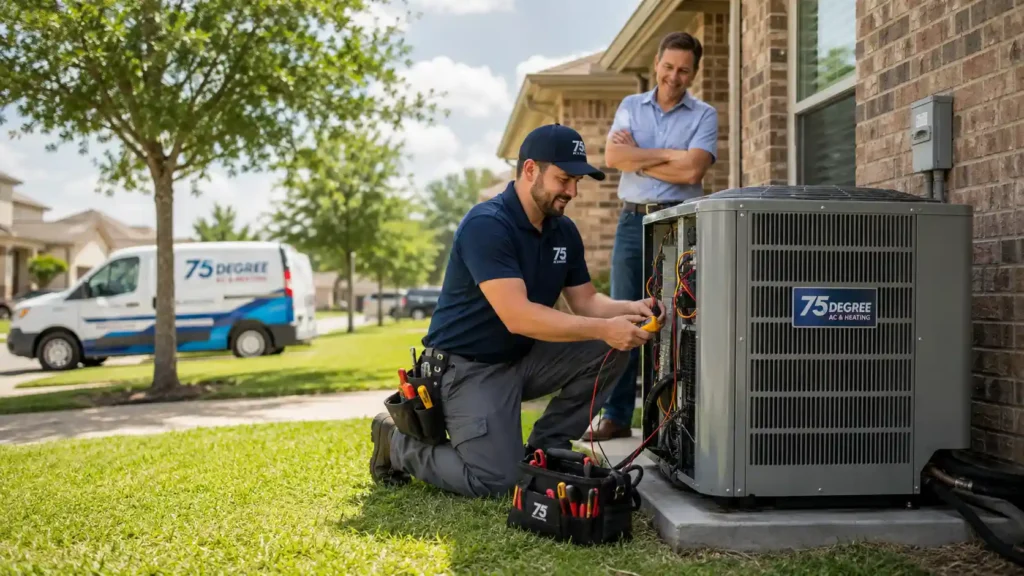
What “Free HVAC Repair” Actually Covers in Cypress
People search for this, so it deserves a straight answer rather than a discount. Four things genuinely can be free, and one thing is not.
A replacement estimate
Quoting a new system costs us time and no parts, so it is free here and at most companies.
Manufacturer parts warranty
Most equipment carries five to ten years on parts, but only if it was registered inside the manufacturer’s window, usually 60 to 90 days after installation. If it was, an ignitor or a board can be covered outright. Worth checking before you approve anything.
Labor warranty inside its term
If we did the repair and the same part fails inside the warranty period, that is on us.
A covered home warranty claim
If you hold a policy, the failure may be theirs to pay. We will tell you when it looks like one.
Not free, at any honest company: somebody’s time to find out what broke. A technician driving to Cypress and diagnosing a no-start is a real cost, and a company advertising it at zero is recovering it somewhere in the repair price. Ours is disclosed and it is credited when you approve the work; the full detail sits on our Cypress AC repair page.
When Only Half the System Is Worth Replacing
The common Cypress version of this question: the air conditioner is fifteen years old, the furnace went in the same week, and one of them has just failed. Does the other one have to go too? Usually not. Here is what actually forces a pair, and what does not.
Check whether it is a package unit
If both halves live in one outdoor cabinet, they generally replace together because they are one product.
Check the coil match
Replacing an outdoor condenser means matching the indoor coil to it. The furnace itself, the part that makes heat, is a separate machine and often does not need touching.
Check the refrigerant generation
A system built from 2025 onward uses R-454B, which is not interchangeable with the older R-410A. That constrains the cooling side. It says nothing about the furnace.
Check the warranty status of the half that still works
A registered furnace with four years of parts coverage left is not a candidate for replacement.
Ask what failed, not how old it is
A fifteen-year-old furnace with a cracked ignitor has a $250 problem. A fifteen-year-old furnace with a cracked heat exchanger has a different conversation entirely, and that one is about safety rather than economics.
One more thing gets overlooked in this conversation, and it belongs to both halves at once: the ductwork. The same runs carry heated and cooled air, so a duct problem shows up as an air conditioning complaint in August and a heating complaint in January, and gets diagnosed as two separate faults by anyone treating the halves as separate systems. If a room was hard to cool in July and is hard to heat in December, the equipment is probably not the thing that is wrong.
75 Degree AC quotes the failed half on its own and prices the pair separately when the pair is genuinely warranted, so you can see both numbers rather than one. If you want the full replace-or-repair arithmetic on a whole system, our Katy HVAC repair page works through it.
Cypress ZIP Codes and Areas 75 Degree AC Covers
We repair heating and cooling equipment across Cypress and the surrounding unincorporated stretch of Harris County. The ZIP you are in is a fair predictor of which half of the system we are coming out for.
Where We Work, and What Is Usually Installed There
| ZIP | What it covers | What is usually in the attic |
|---|---|---|
| 77429 | Central and eastern Cypress, the older Cy-Fair stock, the Huffmeister corridor | Mostly gas furnaces paired with split-system air conditioning. Many are on their second AC and their first furnace |
| 77433 | The western master-planned side | Newer equipment, and a higher share of heat pumps and dual-fuel systems, which fail at the reversing valve rather than at an ignitor |
| 77410 | The northern edge and PO Box area | Mixed. Treated the same on the schedule and at the same rate |
Trucks for Cypress leave the Houston shop at 4800 W 34th Street and run north-west up US-290. Nothing about a Cypress address changes the rate.
Also in range: Jersey Village, Spring, and north along the Grand Parkway. Adjacent coverage: Tomball and Katy.
Related HVAC Services in Cypress
Everything below runs out of the same Houston shop, the same trucks and the same license.
AC repair in Cypress
Covers the August side of this: what a diagnostic includes, what we charge on a weekend, who issues a permit out here, and how the newer master-planned homes fail differently.
HVAC services in Cypress
Covers installation, maintenance, indoor air quality and commercial work for the same three ZIP codes.
HVAC repair in Katy
South across the Grand Parkway, and the page to read for the full replace-or-repair arithmetic on a whole system.
AC repair in Tomball
North up SH-249, the next stop on the same dispatch run.
Cypress HVAC Repair Questions, Answered
Twelve questions taken from live search data rather than invented. Half of them are about the heating side, because that is the half nobody writes about.
Nationally in 2026, HVAC service calls run about $75 to $200, with most weekday daytime calls landing between $99 and $159. Ours sits below that common band and is credited when you approve the repair. The full breakdown, including evenings and weekends, is on our Cypress AC repair page.
Run capacitors first, then hot surface ignitors, contactors and flame sensors. Two of the four most common failures are on the heating side, and all four are inexpensive parts. Compressors and heat exchangers are far rarer and far more expensive.
Almost always a dirty flame sensor. Carbon builds on the sensor rod until it can no longer confirm that a flame is present, so the control board shuts the gas off as a safety response. Cleaning it runs about $75 to $150 and takes a few minutes.
Generally $150 to $400 installed, with a national average near $175. The part itself is often $15 to $100. Hot surface ignitors crack from thermal cycling, usually somewhere between three and seven years of use.
Yes, and October is the time to do it. Set the thermostat to heat, raise the setpoint five degrees and let it run fifteen minutes. It should light, stay lit, and stop smelling of burnt dust within a minute or two. Finding a fault then rather than in January is the whole point.
Yes. 75 Degree AC holds one Texas Class A license covering both, and the trucks carry parts for both. One call, one company, whichever half stopped.
Replacement estimates are free. So is a part covered by a registered manufacturer warranty, or a repair inside our own labor warranty. Diagnosing a fault is not free at any honest company, because it costs a drive and a technician's time.
Yes, all three, plus Jersey Village, Spring and the Huffmeister corridor. Trucks run up US-290 from West 34th Street in Houston.
Usually not, unless it is a package unit where both halves share one cabinet. Replacing a condenser means matching the indoor coil, but the furnace is a separate machine. We quote the failed half on its own so you can see both numbers.
Yes. Goodman is heavily represented in the 2000s-onward Cy-Fair building stock, so it is one of the brands we open most often out here. 75 Degree AC repairs all major residential brands and holds no factory dealership with any of them.
It is a fracture in the metal chamber that separates combustion gases from the air you breathe, caused by years of heating and cooling cycles. You would not reliably know by looking. It is found with a combustion analyzer and a visual inspection, and it is a safety finding rather than a comfort one.
Same-day in most cases when the call lands early enough in the day, running up US-290 from the Houston shop. First cold snaps are the exception, because everybody calls in the same forty-eight hours. ---
HVAC Repair in Cypress: Call (713) 598-2737
Heat out, air conditioning out, or something in between: 75 Degree AC works on both halves of the system and carries parts for both on the truck. You get told which part failed and what it costs before anything is opened, whichever side of the year it is.
Texas license TACLA72152E. Houston-local since 2016. Covering 77429, 77433 and 77410. (713) 598-2737 reaches a person. There is also a booking form if the house is cold and you would rather just get on the schedule.