- (346) 681-2625
- info@75degreeac.com
- 4800 W 34th St C50F, Houston, TX 77092, United States

- Licensed TACLA72152E
- 77478, 77479 and 77498
AC Repair in Sugar Land, TX Same-Day Service
- $89 Diagnostic, Credited on Approval
- Every Price Named to a Part
- Dispatched From Richmond





Same-Day AC Repair Across 77478, 77479 and 77498
Sugar Land, Texas is served by 75 Degree AC for residential and light-commercial air conditioning repair across 77478, 77479 and 77498, dispatched from the company’s Richmond branch roughly ten miles from the city center. 75 Degree AC holds Texas licence number TACLA72152E with a Class A endorsement, checkable against the public register kept by the Texas Department of Licensing and Regulation. A diagnostic visit is priced at $89 and deducted from the invoice once a repair is authorized. What separates one Sugar Land repair bill from another is usually age, not luck. First Colony has been building since 1976 and Telfair and Riverstone went up in the 2000s and 2010s, so a single city limit contains something like four decades of equipment. The oldest of it still runs on R-22, a refrigerant that is no longer manufactured, and that fact does more to shape the cost of a leak repair than any other variable on the invoice.
Three ZIP codes, and treating them as one area is how companies end up quoting a 1979 house at 2015 prices. 77479 is the biggest, holding First Colony and Sugar Creek. 77478 wraps the older center and Town Square. 77498 takes the lakes side. 75 Degree AC covers all three, and the vans that reach them start at the Richmond branch, not at the Houston shop.
Then there is the calendar. National Weather Service normals for 1991 to 2020 put the Houston area at 33 days a year of 95°F or hotter, and 2011 managed 108 of them. Equipment that limps through spring does not limp through that.
- All three ZIP codes: 77478, 77479 and 77498
- First Colony, Sugar Creek, Telfair, Riverstone and New Territory
- Residential split systems, packaged units and light commercial
- Same-day scheduling when the call lands early enough in the day
Rates do not change at the Sugar Land boundary. 75 Degree AC prices a call in First Colony exactly as it prices one in Richmond.
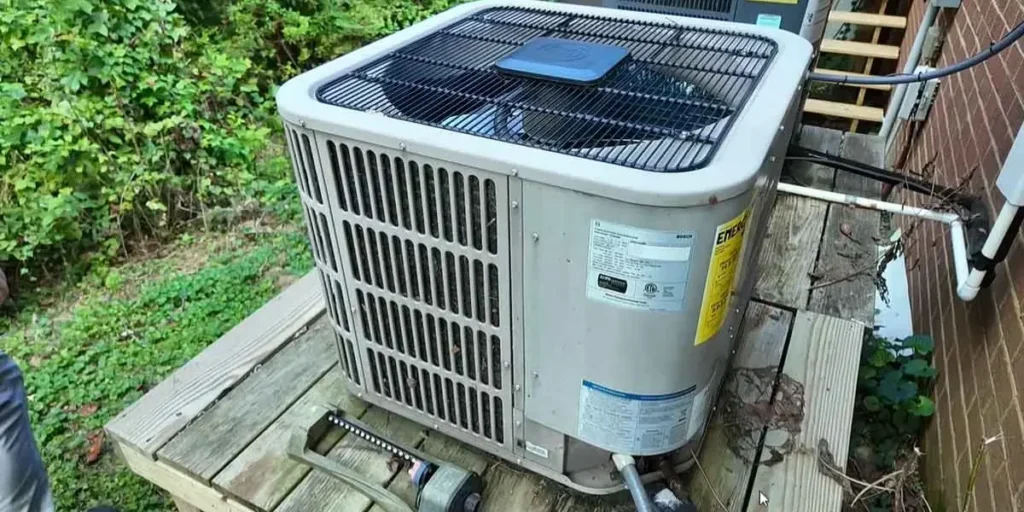
The $89 Covers Finding Out, and It Comes Back Off
Of the four offers in this market, the diagnostic is the one built for a system that has actually stopped working. It is not a call-out charge and it is not an inspection: it pays for somebody to establish which component failed, using instruments rather than intuition.
75 Degree AC hands over six numbers by the end of the visit. A temperature split measured across return and supply. A microfarad reading taken off the capacitor and compared against the figure printed on its own can. Contactor condition. Voltage at the unit while it is trying to start. Refrigerant pressures, recorded next to the outdoor temperature they were read at, because pressures without that are decoration. And the state of the condensate line and float switch.
Then a price, in writing, before anything else is opened.
Say yes and the $89 stops being a line on the invoice. Say no and the six numbers are still yours to keep, which is the part worth paying attention to. Those figures travel. They are what turn the next quote you receive into something you can check rather than something you have to believe. A company unwilling to write down what it measured is selling you a verdict without the evidence.
75 Degree AC charges the same $89 at night, at weekends and on holidays. No multiplier. When it is the furnace rather than the air conditioner, our Sugar Land HVAC repair page sets out what has actually changed about repair costs since 2022.
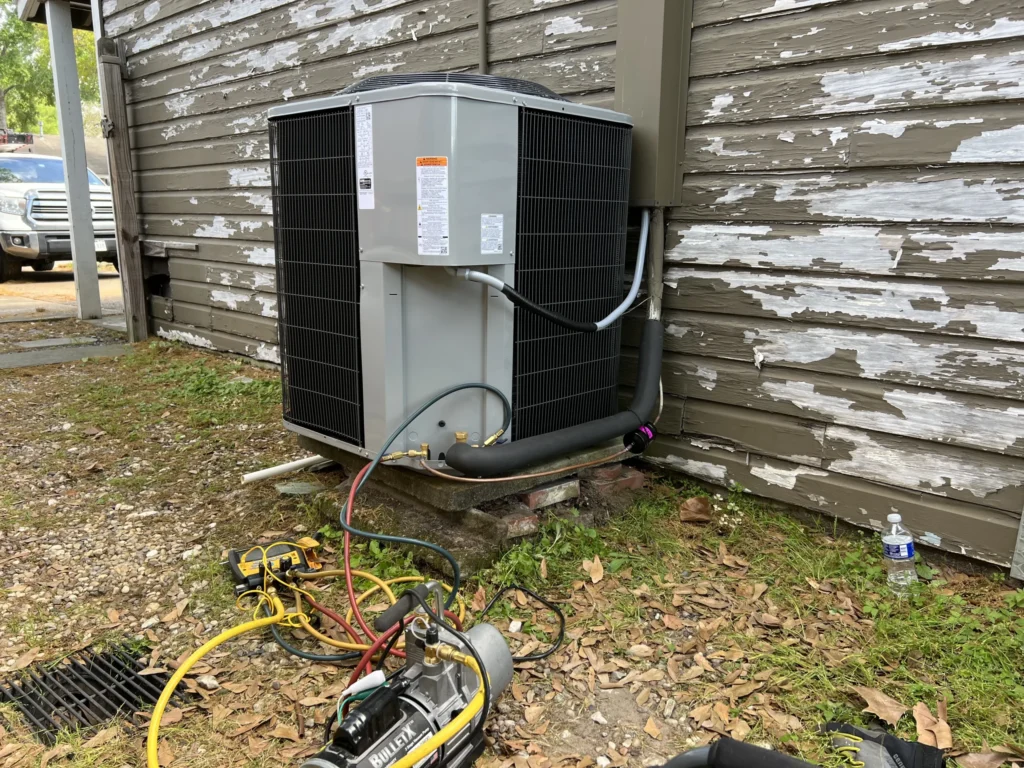
Why Is My AC Running but Not Blowing Cold Air?
Because moving air and moving heat are two different jobs, and only one of them has stopped. The blower can run beautifully while the half of the system that actually removes heat from your house sits dead outside. Standing at a vent, you cannot tell the difference between four separate faults.
Ranked by how often they turn up on Sugar Land calls:
- The run capacitor gave out. Listen at the outdoor unit: a hum with no blade movement. Cheapest genuine repair there is.
- The condenser coil is choked. Heat has nowhere to go, so the machine runs without end and cools nothing. Tight side-yard installations collect the worst of it.
- Charge has dropped through a slow leak. The giveaway is air that is cool but never cold, with airflow that seems perfectly normal.
- The contactor burned out. Indoors everything sounds healthy. Outdoors nothing ever switches on.
- The condenser fan motor seized. The compressor labours, no air crosses the coil, and the system eventually shuts itself down on pressure.
Five minutes and one measurement narrows it. Return air against supply air should differ by something close to 20°F. A much smaller gap implicates charge or the coil; no gap at all sends us outside.
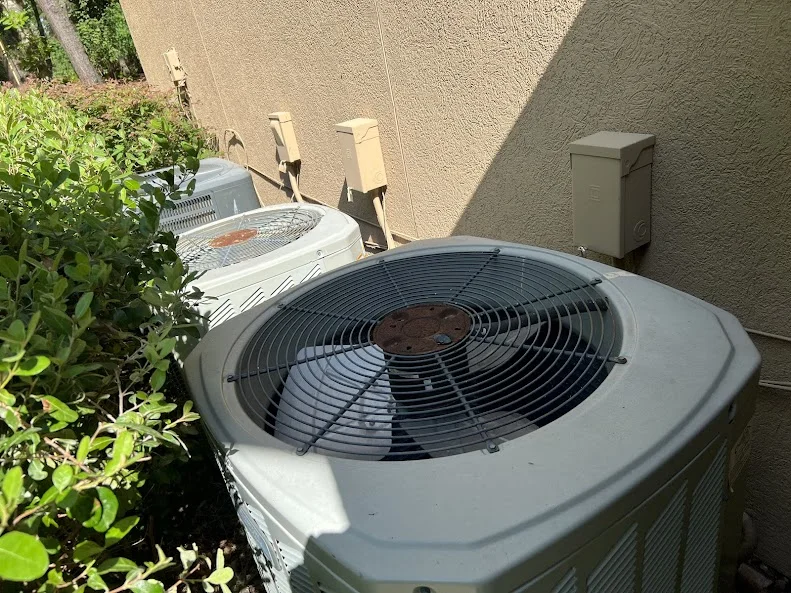
What Is the Most Common AC Repair?
Capacitor replacement, by a wide margin, and it is also the cheapest thing on the list. That gap between how common it is and how expensive people fear it is, is where a lot of unnecessary replacements get sold.
A run capacitor is a cylinder about the size of a soda can that gives the motor the push it needs to start. They fail from heat, and Houston supplies plenty. When one goes, the outdoor fan hums without spinning and the house stops cooling, which feels exactly like a dead compressor to anybody standing in the kitchen.
The distinction matters because the two sit at opposite ends of the price range. A capacitor is $150 to $320 and finishes on the visit. A compressor is $1,800 to $2,200 and is a different day. Anyone who quotes you the second without showing you a microfarad reading that rules out the first has skipped a step that takes ninety seconds.
Behind capacitors, in order: contactors, condensate blockages that trip the float switch, condenser fan motors, and then the genuinely expensive category of sealed-system faults.
Why a Sugar Creek System and a Telfair System Get Different Answers
Sugar Land is unusual for a Houston suburb in that it holds about four decades of housing inside one city limit. First Colony began developing in 1976 across 9,700 acres and now runs to something like 98 neighborhoods and 50,000 residents. Sugar Creek is older still. Telfair and Riverstone went up in the 2000s and 2010s. New Territory sits in between.
That spread is why a single repair-or-replace rule of thumb does not work here, and why we will not give you one on the phone.
- Original and early-First-Colony stock. Frequently on its second or third system by now. Some of what remains predates R-410A entirely. Repairs here are judged against refrigerant availability as much as against age.
- 1990s New Territory and the later First Colony sections. The first R-410A generation, now old enough that coil and compressor decisions tend to arrive in the same year.
- 2000s Telfair and Riverstone. Builder-installed equipment now fifteen to twenty years old, mostly failing on electrical parts rather than sealed-system faults. These are usually worth repairing.
- The newest stock. Controls, drains and capacitors. Almost never the compressor.
The practical version: on a 2008 Telfair system, a $400 electrical repair is nearly always the right spend. On a 1985 Sugar Creek system with a leaking coil, it usually is not, and the reason is refrigerant.
Bring Us the Quote You Already Have
A good share of our Sugar Land calls start with a piece of paper somebody else left behind. If that is your situation, bring it to the conversation rather than hiding it.
75 Degree AC will put instruments on the system independently and tell you whether the figure in front of you matches the condition of the equipment. Frequently it does. There are capable companies working this city and inventing a disagreement to win a job would be a poor way to earn one.
The useful thing here is not another opinion. Opinions cancel each other out and leave you exactly where you started, holding two stories and no way to choose between them. Measurements do not behave that way. A homeowner with a microfarad reading and a temperature split can test both quotes against the same physical facts.
You pay the $89, and it comes off if the work ends up with us. If the first company had it right, $89 was the cost of finding that out before spending several thousand on the strength of a hunch.
What AC Repair Costs in Sugar Land, by the Part That Failed
Here is the table the rest of this search result does not have. Every row names the component, because a price without a part attached is not a quote, it is a mood.
| What the system is doing | The part that usually did it | Typical range | Finished same visit? |
|---|---|---|---|
| Outdoor fan hums, will not spin | Run capacitor | $150 to $320 | Yes, almost always |
| Nothing happens when the thermostat calls | Contactor, or the low-voltage circuit | $150 to $300 | Yes |
| Water in the pan, or the system shut itself off | Clogged condensate line, float switch tripped | $150 to $300 | Yes |
| Outdoor unit runs, air never gets cold | Condenser fan motor | $400 to $700 | Usually |
| Blower turns, airflow is weak | ECM blower module, or static pressure | $400 to $900 | Sometimes, motor depending |
| Cools poorly, ices up, runs constantly | Refrigerant leak, located and repaired | $300 to $900 | Depends on access |
| Cools poorly on an older system | TXV, metering fault | $450 to $850 | Usually |
| Evaporator coil, under warranty | Coil | $1,000 to $2,500 | No, order and return |
| Evaporator coil, out of warranty | Coil | up to $4,500 | No |
| Compressor replacement | Compressor | $1,800 to $2,200 | No |
Read the right-hand column before the middle one. The parts that finish on the first visit are the ones we carry, and they cover the large majority of Sugar Land calls. The rows that need a return trip are the ones where something has to be ordered, and you should be told that on the phone rather than discovering it at five o’clock.
Whether a Maintenance Plan Is Worth It, Honestly
Maintenance plans are one of the most asked-about and least explained products in this trade. The honest answer is that they are worth it for some houses and are quietly wasted money for others, and which one you are depends on things a salesperson cannot see from a call center.
A plan is worth it when:
- You will actually use both visits. Most people who buy plans use one.
- Your system is between roughly eight and eighteen years old, where catching a weak capacitor or a slow drain clog in spring genuinely prevents a July failure.
- Your outdoor unit sits somewhere that collects debris, or your drain line runs long through an attic.
- Priority scheduling matters to you in August, which is the one month it is genuinely hard to buy.
A plan is not worth it when:
- The system is under three years old and still fully under manufacturer warranty.
- The system is old enough that you are replacing it inside two years anyway.
- You would not have called for the second visit regardless.
We would rather write that down than sell you a subscription you forget you have. Ask on the phone and we will tell you which category your system is in before anyone quotes a plan.
What Each Pricing Offer in This Market Actually Buys
You will meet four different offers searching for AC repair in Sugar Land, and they sound similar enough that people book the wrong one. They are not variations on a theme. They buy different things.
| What you are offered | Typical figure here | What it includes | What it does not | When it is right |
|---|---|---|---|---|
| Low-cost tune-up | $79 to $99 | An inspection, a basic clean, readings taken | Parts, refrigerant, or any actual repair | Pre-season check on a system that is working |
| Diagnostic fee | $89 to $99 | Measured fault-finding, and the readings in writing | The repair itself, until you approve it | Something is genuinely wrong right now |
| “Free estimate” | $0 | A quote to replace the system | Diagnosing a fault on a system you intend to keep | You have already decided to replace |
| Maintenance plan | annual fee | Scheduled visits, priority scheduling, a discount rate | Parts beyond whatever the plan terms say | You will genuinely use two visits a year |
The verdict is short: a tune-up is not a diagnosis, and a free estimate is not a free diagnosis. If your AC is broken today, the tune-up is the wrong product and the free estimate is a conversation about replacing it. The honest answer for a fault is a paid diagnostic, and the fair version of that is one credited back when you approve the work.
None of this makes the cheap offers dishonest. A $79 tune-up is a reasonable thing to sell and a reasonable thing to buy, in April, on a system that is fine. It becomes a problem only when it is bought in July by somebody whose compressor is failing, because the visit cannot fix that and was never priced to.
What Happens When You Call (346) 681-2625
A person picks up at the Richmond branch, ten miles west, and asks four things before anything gets scheduled: where you are, what the equipment is doing, how long it has been doing it, and whether anybody in the house struggles in heat. That last answer moves you up the route.
- Somebody at the Richmond branch picks up. No diagnosis over the phone, but the symptom decides what goes on the van.
- The window and the $89 are stated up front, before you commit to anything at all.
- You get a call as the previous job wraps, instead of a four-hour silence and a guess.
- Instruments first, written number second, your call third. That order does not vary.
- The common failures are stocked on the van, so the majority of these visits end with the house cooling again.
Stafford sits directly east and runs off this same branch. If you rent there rather than own, the rules are different and worth reading before you call anybody: see what a Stafford renter can actually do about it.
What the Refrigerant in Your System Says About the Repair Bill
Not one of the ten pages ranking for this search mentions refrigerant. It is the single biggest hidden variable in what an older Sugar Land repair costs.
| Refrigerant | Roughly which systems | Status | What it does to a repair |
|---|---|---|---|
| R-22 | installed up to around 2010 | No longer produced. Service relies on reclaimed stock | A leak repair gets expensive fast, and the cost only moves one way |
| R-410A | roughly 2010 to 2024 | Phasing down under the EPA’s AIM Act | Still available and still sensible to repair, with cost drifting up over time |
| R-454B | 2025 onward | Current in new equipment | Not a factor in repairs yet |
Here is the honest consequence, and it is the opposite of what a sales conversation usually does with this information. R-22 does not make your system illegal, unusable, or urgently in need of replacement. If it holds charge, it can keep running for years. What it changes is the maths on a leak specifically: recharging an R-22 system that leaks is spending real money on something that will leak again, against a supply that is not being replenished.
So the question is never “what refrigerant is it”. It is does it leak. A 1998 system that has not lost charge in five years is a perfectly reasonable thing to keep. The same system needing two pounds a season is telling you something.
How 75 Degree AC Diagnoses Before Quoting
Sequence beats checklist. Work the cheap, common suspects before the expensive, rare ones and a diagnosis stays a diagnosis; work them in the other order and it quietly becomes a sales call. 75 Degree AC releases those readings either way, approved repair or not. One rule we hold to regardless of what it costs us: find the leak, fix the leak, then charge the system. Adding refrigerant to something nobody has pressure-tested is a sale dressed as a repair.
Establish what changed and when
Failed overnight, or faded across three weeks? Those point at different parts entirely, and the answer costs nothing to get.
Measure the split
Return against supply, looking for something near 20°F. This single number decides whether we open the indoor half or the outdoor half.
Go electrical next
Microfarads off the capacitor, contactor condition, voltage under load. Most Sugar Land faults are found here, in minutes, for a couple of hundred dollars.
Then airflow
Filter, coil face, blower wheel, static pressure. A fair share of “it stopped cooling” turns out to be restriction rather than failure.
Gauges last, never first
Superheat and subcooling, logged against ambient. Pressures on their own mean nothing.
Price it in writing before anything else opens
Component, labor, and what we do if the first fix does not stick.
Brands and Systems We Repair in Sugar Land
75 Degree AC repairs what is actually installed here, which across four decades of building means most of the major brands and a good deal of builder-grade equipment. 75 Degree AC carries no factory-authorized dealership with any manufacturer, and you should be suspicious of pages that imply otherwise without naming the programme. What we do not work on: window units, portable units, and automotive air conditioning.
Carrier
Infinity and Performance series, including the variable-speed condensers common in the newer Riverstone and Telfair builds.
Trane and American Standard
Same equipment under two badges. We service both and claim factory authorization for neither.
Lennox
Merit and Elite tiers. On the older Merit units the constraint is parts availability, not diagnosis.
Goodman
Heavily represented in the 2000s Telfair and Riverstone builds, which makes it the brand we open most often here.
Rheem and Ruud
Straightforward equipment. The capacitors and contactors that fail on them ride on the van.
Daikin, including ductless
Multi-zone and mini-split, more common on Sugar Land additions and converted garages than on original builds.
Sugar Land AC Repair Questions, Answered
Twelve questions taken from live search data rather than invented. Six of the ten usable questions Google reports for this search are about money, so most of these are too.
Budget $89 for the diagnosis, then anywhere from $150 to $900 for the fix itself, with the part deciding where you land. Electrical components sit at the cheap end, motors and refrigerant work at the dear end. Sealed-system jobs are their own category: coils out of warranty climb toward $4,500 and compressors run $1,800 to $2,200. Authorise the repair and the diagnostic charge disappears.
Six measurements and a written price. Temperature split, capacitor microfarads checked against the can's own rating, contactor condition, voltage under load, refrigerant pressures logged against outdoor temperature, and the state of the drain line and float switch. Nothing further gets opened until you have seen a number. Those readings stay with you regardless of whether we do the work.
Inspection, basic clean, readings. No parts, no refrigerant, no repair of any kind. Bought in April on equipment that runs fine, it is a sensible product. Bought in July because the house has stopped cooling, it cannot deliver what you need, since nothing about that price was ever meant to cover a failed component. You will simply receive a second quote for the actual work.
They are different products and the gap between them costs people real money. Around here, a free estimate almost always means somebody will quote you for a **new system** at no charge. Working out why an existing system misbehaves is skilled diagnostic labor and normally carries a fee. Ask any company offering free diagnosis what happens when the answer turns out to be a $200 part.
For some houses, genuinely. The maths works when both annual visits actually get used, when the equipment is somewhere between eight and eighteen years old, and when jumping the queue in August has value to you. It stops working on a system under three years old that the manufacturer still covers, or on one you already intend to replace. Ask before buying and we will say which yours is.
Moving air and removing heat are separate functions, and the second one has failed. Most commonly the run capacitor, leaving the outdoor fan humming without turning. After that: a coil too dirty to shed heat, charge lost to a slow leak, a burned contactor, or a seized condenser fan motor. If return and supply air differ by much less than 20°F, suspect charge or the coil.
Replacing a run capacitor, and nothing else is close. It costs $150 to $320 and finishes while the technician is still there. The reason it matters is that a dead capacitor and a dead compressor produce identical symptoms indoors, and the compressor is a $1,800 to $2,200 job. Ninety seconds with a meter tells them apart, so any replacement quote issued without that reading skipped a step.
Take the equipment's age in years, multiply by the quoted repair cost, and compare the answer to $5,000. Above it, replacing tends to win; below it, repairing does. Use it as a conversation starter rather than a ruling, especially in a city holding four decades of housing. Spending $400 on electrical work in a fifteen-year-old Telfair home fails the arithmetic and is still obviously correct.
It describes the built-in delay that stops a compressor restarting immediately after it shuts down. Roughly three minutes must pass before it will attempt to start again, which protects it from starting against high head pressure. The pause is deliberate engineering, not a breakdown. Homeowners who read it as a dead system and keep cycling the breaker do genuine damage.
Gladly. Bring the paperwork, we will put instruments on the system, and you will hear whether the figure fits the equipment's actual condition. Often it does, and we say so. The value is a second set of measurements rather than a second opinion, because measurements can be checked and opinions cannot. Standard $89, credited if the work comes to us.
Every one of them. The city occupies 77478, 77479 and 77498, and we work throughout all three. First Colony and Sugar Creek fall in 77479, the older center and Town Square in 77478, the lakes in 77498. Vans run from the Richmond branch roughly ten miles away, and nothing about a Sugar Land address changes the rate.
We do not. 75 Degree AC handles home and light-commercial systems, never vehicles. It is worth stating because the search results here mix the two together and people book the wrong trade. A vehicle problem needs an automotive shop. A house that will not cool is ours.
Related HVAC Services in Sugar Land, TX
AC repair is one call among several a Sugar Land house needs across its life, and the older parts of this city need most of them eventually. Everything below runs out of the same Richmond branch and the same licence.
HVAC services in Sugar Land
The full range for this city: heating, air quality and whole-system work alongside cooling.
AC repair, how we do it
How we work everywhere else in the metro, and what we will not do.
AC repair in Richmond
The branch these Sugar Land vans actually leave from, ten miles west.
AC repair in Rosenberg
Further out in Fort Bend County. Worth reading if your question is about permits on a changeout.
AC repair in Missouri City
East along the county line, and the page to read if your complaint is thermostat setpoint rather than a fault.
AC repair in Katy
North across the Grand Parkway, where drain-line clogs are the recurring theme.
Sugar Land Neighborhoods and ZIP Codes We Cover
Three ZIP codes, all covered, and the differences between them are real rather than administrative. The vans that reach them start at the Richmond branch about ten miles west, not at the Houston shop, and nothing about a Sugar Land address changes the rate. Call (346) 681-2625 and the window we quote is the window you get.
Where We Work, and What We Usually Find There
| ZIP | What it covers | What we usually find |
|---|---|---|
| 77479 | First Colony, Sugar Creek and the south | The widest age range in the city. First Colony alone spans from 1976 to the 2000s, so two houses on the same street can need opposite answers |
| 77478 | Downtown, Sugar Land Town Square, the older center | Mixed stock and more retrofits. Duct problems outnumber equipment problems here more than anywhere else in the city |
| 77498 | The lakes side | Newer on average. Failures skew to controls, drains and capacitors rather than sealed-system faults |
| First Colony | 77479 | 9,700 acres, developed from 1976, roughly 98 neighborhoods. Its two ends are effectively different cities as far as equipment age goes |
| Sugar Creek | 77479 | The older stock. Where R-22 questions actually come up, and where a leak changes the whole calculation |
| New Territory | 77479 / 77498 | 1990s master-planned. First-generation R-410A, now at the age where coil decisions arrive |
| Telfair | 77479 | 2000s. Builder equipment, mostly electrical faults, and usually worth repairing |
| Riverstone | 77479 | Newer, spilling toward Missouri City. Controls and drains |
| Coverage | Detail |
|---|---|
| ZIP codes | 77478, 77479 and 77498 — all three |
| County | Fort Bend County, the same county as Richmond and Rosenberg |
| Dispatch | The Richmond branch, 20926 Bright Lake Bend Ct, about ten miles west |
| Housing span | Roughly four decades. First Colony from 1976, Telfair and Riverstone from the 2000s |
| Diagnostic | $89 flat, credited in full on approval. No after-hours, weekend or holiday surcharge |
| License | TACLA72152E, Class A with no tonnage ceiling, verifiable through TDLR |
Vans for Sugar Land leave from the Richmond branch at 20926 Bright Lake Bend Ct, about ten miles west. The Houston shop is roughly seventeen miles the other way.
Elsewhere in Fort Bend County we cover Richmond, Rosenberg and Missouri City. The Sugar Land HVAC page covers heating, air quality and whole-system work alongside cooling.
Same-Day AC Repair in Sugar Land: Call (346) 681-2625
Ring the Richmond branch, ten miles west, and a person picks up. Describe the symptom and you will hear which parts we are bringing and what time we can be at the door.
Diagnosis $89, credited back on approval, and not a single figure on your invoice that is not tied to a component. Covering 77478, 77479 and 77498. Licensed as TACLA72152E, working this county since 2016. Weekends and evenings are not priced differently. (346) 681-2625, or book online if you would rather not talk to anyone.