- (346) 681-2625
- info@75degreeac.com
- 4800 W 34th St C50F, Houston, TX 77092, United States

- Licensed TACLA72152E
- 77471 and 77469
AC Repair in Rosenberg, TX Same-Day Service
- $89 Diagnostic, Credited on Approval
- No After-Hours Surcharge
- Dispatched From Richmond





Same-Day AC Repair Across 77471, 77469 and Fort Bend County
75 Degree AC repairs residential air conditioning in Rosenberg, Texas, covering both of the city’s ZIP codes, 77471 and 77469, across Fort Bend County. The company holds Texas licence TACLA72152E, a Class A endorsement with no tonnage ceiling, verifiable through the Texas Department of Licensing and Regulation. Diagnosis costs $89, and that fee is credited toward any repair the homeowner approves. Most Rosenberg AC failures fall into a narrow set: a failed run capacitor, a burned contactor, a seized condenser fan motor, or a clogged condensate line that trips the float switch. Rosenberg’s housing stock was built primarily in the 2000s, so a large share of the city’s systems are now twenty to twenty-five years old and reaching the repair-versus-replace decision. A straight repair needs no City of Rosenberg permit. A replacement does, and it costs $20 plus 2% of the total job cost.
Rosenberg sits inside two ZIP codes and nothing else. 77471 covers the bulk of the city. 77469 runs along the Richmond side, which is why some companies quote Rosenberg addresses as though they were out of area. 75 Degree AC covers both, and the crew that reaches you comes from the Richmond branch rather than from Houston.
Heat is the reason the calendar matters here. Houston averages 33 days a year at or above 95°F, and the record is 108 days, set in 2011, according to National Weather Service climate normals for 1991 to 2020. A system that is merely weak in April becomes a two-day problem in July.
- Both city ZIP codes, 77471 and 77469
- Summer Lakes, Bonbrook Plantation, Seabourne Creek and the Brazos Town Center area
- Downtown Rosenberg and the older housing north of Avenue H
- Residential split systems, packaged units and light commercial
- Same-day scheduling when the call comes in early enough in the day
We charge Rosenberg addresses the same rates as Richmond addresses. There is no travel surcharge for crossing the city line.
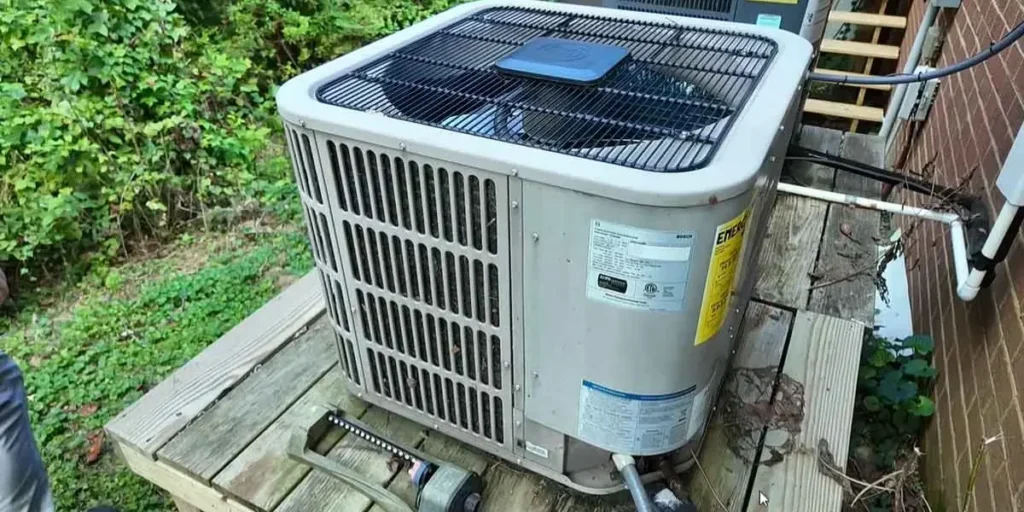
What $89 Buys, and What Happens to It When You Approve the Repair
The $89 is a diagnostic fee, not a call-out fee, and it buys a specific piece of work rather than an opinion. A technician measures the system, finds the fault, and writes down what the readings were. If you approve the repair, the $89 comes off the invoice. If you do not, you keep the measurements.
Here is what the fee actually covers:
- Static pressure and temperature split measured, not estimated
- Capacitor microfarad reading against the rating stamped on the can
- Refrigerant pressures with the ambient temperature noted alongside them
- Condensate line and float switch checked
- A written quote before any work starts
We charge a flat $89 for that visit and credit it against any repair you approve on the same call. The number does not change at nights or on weekends.
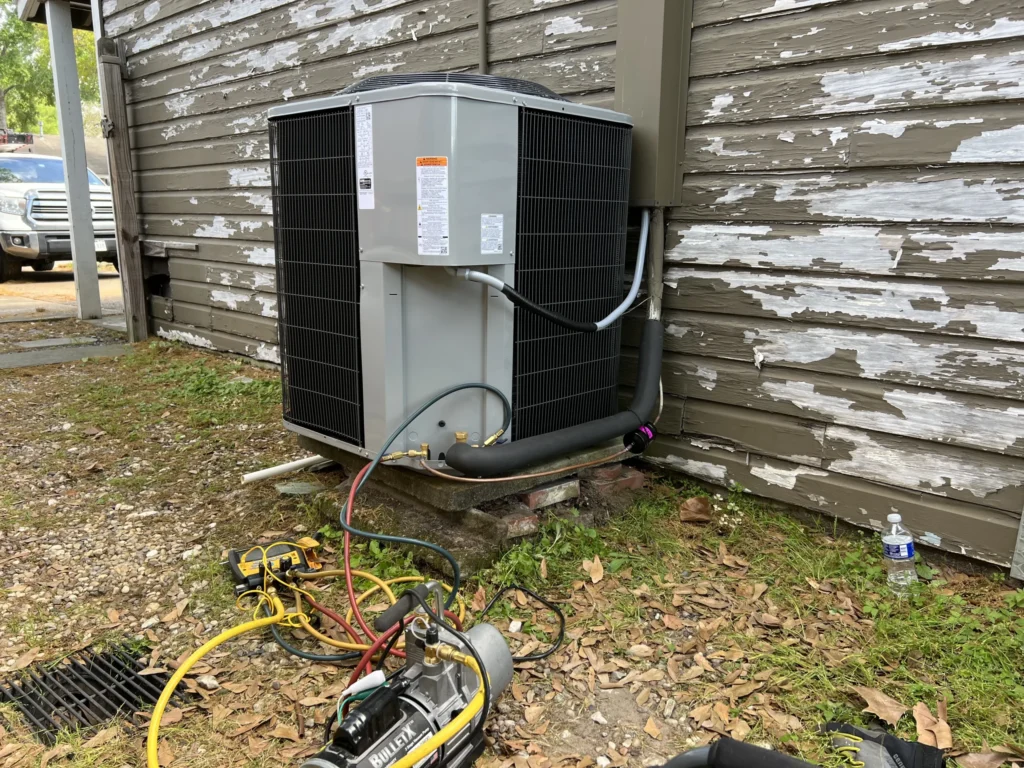
Why Is My AC Running but Not Blowing Cold Air?
An air conditioner that runs without cooling has usually lost its ability to move heat, not its ability to move air. The compressor may be running while the refrigerant charge is low, the outdoor coil may be too dirty to reject heat, or the outdoor fan may have stopped while the compressor kept going. All four feel identical at the vent.
The causes we find most often in Rosenberg homes, roughly in order:
- Run capacitor failed. The outdoor fan hums but does not turn. Cheapest fix on the list.
- Outdoor coil packed with cottonwood and grass clippings. The system cannot dump heat, so it runs continuously and cools nothing.
- Refrigerant charge low from a slow leak. Airflow feels normal, the air is merely cool rather than cold.
- Contactor burned. The outdoor unit never energizes at all while the indoor blower keeps running.
- Thermostat calling for fan instead of cool. Rare, free to fix, and worth ruling out before anyone opens a panel.
One measurement separates most of these in about five minutes. The temperature split between return and supply air should sit near 20°F. Well below that points at charge or the coil. Nothing at all points at the outdoor unit.
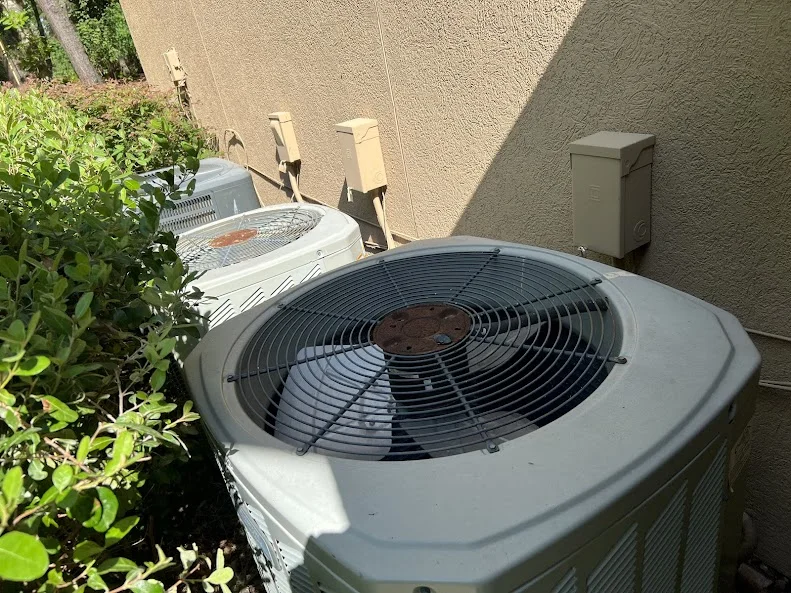
Why Rosenberg’s 2000s-Built Systems Are Failing Now
Rosenberg’s housing stock was built primarily in the 2000s. The city grew fast alongside it: 30,618 residents in 2010, 38,282 in 2020, roughly 42,882 by 2025. Which means a large share of Rosenberg homes are still running original equipment, now twenty to twenty-five years old, all of it arriving at end of life inside the same few years.
What that looks like on a service call:
- Original builder-grade equipment, not premium tiers. Subdivision packages of that era favored entry-level condensers, which is not a defect but does shorten the tail.
- Undersized returns. Airflow complaints on 2000s tract housing are frequently duct problems misread as capacity problems.
- First-generation R-410A systems. The earliest R-410A equipment in these neighborhoods is now old enough that coil and compressor decisions arrive together.
- Attic air handlers with long drain runs. More linear feet of condensate line means more places for a clog to start.
The practical consequence is that a second opinion is worth more in Rosenberg than in a city with a mixed-age housing stock. When every system on the street is the same age, “it is time to replace” is an easy thing to say and a hard thing for a homeowner to test. The same housing split shapes the heating side of the same system, where the city runs mostly on electricity instead of gas.
What the Beryl Outage Did to Rosenberg Condensers
Hurricane Beryl took power from 208,988 Fort Bend County customers on 9 July 2024, roughly 59% of the county, and CenterPoint Energy staged more than 650 restoration personnel at the Rosenberg fairgrounds. Some Rosenberg addresses went four days without power. Air conditioners rarely fail during the outage itself, though. They fail on the way back.
The mechanism is dull, and worth understanding anyway. A grid restoration is not a clean switch: voltage can come back uneven, and a compressor asked to start against high head pressure, or on low voltage, pulls current it was never built to pull. Capacitors and contactors take that hit first. Compressors second.
If your system has been through a multi-day outage and is not cooling since, work through this before assuming the worst:
- Check the breaker at the panel and the disconnect at the outdoor unit. Both can trip on restoration. This is the free answer and it is right more often than people expect.
- Give it a full five minutes after restoring power. Many systems hold a built-in short-cycle delay, and impatience gets misread as failure.
- Listen at the outdoor unit. A hum with no fan rotation points at the capacitor. Silence with the thermostat calling points at the contactor or the low-voltage side.
- Look at the thermostat itself. Battery-backed units come back with settings intact. Others return to a default that is not what you had.
- Stop there if none of it works. Repeatedly resetting a breaker on a compressor that will not start is how a $250 call becomes a $2,000 one.
We keep capacitors and contactors for the common Fort Bend equipment on the truck, which is why these particular calls usually finish on the first visit.
Bring Us the Quote You Already Have
If another company has already been out and left you with a number, bring it. 75 Degree AC will measure the system independently and tell you whether the quote matches what the equipment is actually doing. Sometimes it does, and we say so.
This is the single most common thing Rosenberg and Fort Bend homeowners ask for, and it is worth saying why. Search the local HVAC conversation on Reddit and the dominant theme is not workmanship. It is people posting quotes and asking strangers whether they are being taken advantage of, on threads with titles like “Why such a variation in quotes for replacement HVAC.” A homeowner with two independent sets of measurements is in a completely different position from one with two opinions.
The $89 applies, and it is credited if you have us do the work. If the first company was right, you have paid $89 to find that out, which is a reasonable price for sleeping properly.
What AC Repair Costs in Rosenberg, by Symptom
The spread on AC repair is wide because the jobs inside it are not comparable. A capacitor is a twenty-minute call. A sealed-system repair can take most of a day and still leave you with equipment on borrowed time. HomeAdvisor’s Houston figures put the average at $586 inside a $186 to $981 spread, which lines up with what we invoice in Fort Bend County.
| What the system is doing | Usual culprit | Typical range | What moves the number in Rosenberg |
|---|---|---|---|
| Outdoor fan hums but will not spin | Run capacitor | $150 to $320 | Dual-run capacitors are standard on the 2000s builder equipment here |
| Nothing happens when the thermostat calls | Contactor or low-voltage fault | $150 to $300 | Surge-pitted contactors are common on this side of the county |
| Water in the pan, or the system shut itself off | Clogged drain, float switch tripped | $150 to $300 | Attic air handlers in Summer Lakes and Bonbrook run long drain lines |
| Runs all day, never reaches setpoint | Low charge, dirty coil, or nothing at all | $0 to $900 | Whether there is a real fault to find |
| Blower turns but airflow is weak | ECM blower module or static pressure | $400 to $900 | Original 2000s ductwork with undersized returns |
| Refrigerant leak, found and repaired | Coil, line set or fitting | $300 to $900 | Access. A line set buried in slab is a different job |
| Evaporator coil, under warranty | Coil | $1,000 to $2,500 | Attic access and whether the plenum needs rebuilding |
| Evaporator coil, out of warranty | Coil | up to $4,500 | Same job, plus the part |
| Compressor replacement | Compressor | $1,800 to $2,200 | Warranty status is the whole story |
Two rows deserve a second look. “Runs all day, never reaches setpoint” and “blower turns but airflow is weak” are frequently not repairs at all. They are duct and airflow problems wearing an AC costume. The $89 still applies, and you still leave holding the measurements, which is worth something the next time a salesperson tells you the system is undersized.
What Is the $5,000 Rule for AC?
The $5,000 rule is a rough test for whether to repair or replace: multiply the age of the system in years by the repair quote in dollars. If the result clears $5,000, replacement is usually the better spend. If it lands under, repair usually wins. It is a starting point rather than an answer, and in Rosenberg it lands on a lot of systems at once.
Two worked cases from the equipment mix in this city:
A 2004 system in Bonbrook Plantation, quoted $400 for a capacitor and contactor. Twenty-two years old times $400 is $8,800. The rule says replace. The rule is wrong here. A $400 repair on a system that is otherwise holding charge and hitting a normal temperature split buys another season for less than one month of the finance payment on a changeout. Do the repair, and start pricing replacement on your own schedule rather than in August.
A 2006 system in Summer Lakes, quoted $2,600 for an out-of-warranty evaporator coil. Twenty years times $2,600 is $52,000. The rule says replace, and this time it is right. On R-410A equipment of that age, a coil replacement often precedes a compressor failure by a year or two, and you would be spending $2,600 to postpone a decision rather than to settle it.
The refrigerant question sits underneath both. R-410A is being phased down under the EPA’s AIM Act, with R-454B taking over in new equipment. That does not strand your system, and it does not mean refrigerant is unobtainable. It does mean the cost of charging older equipment drifts upward over time, and that drift belongs in the maths on any system past about fifteen years.
We quote the repair and the replacement side by side when a system is close to that line, and say plainly which one we would choose.
What Every Rosenberg HVAC Permit Actually Costs
A repair in Rosenberg needs no permit. A replacement does, and the City of Rosenberg publishes exactly what it costs: a $20 application fee plus 2% of the total job cost, under Resolution R-3576 in the City’s Schedule of Fees. New construction is charged differently, at $10 per ton. Starting the work without pulling the permit adds a $275 investigation fee on top of the permit you still have to buy.
| Job | Job cost | How the permit is calculated | Permit total |
|---|---|---|---|
| Condenser and coil changeout | $7,500 | $20 + 2% | $170 |
| Full system replacement | $11,000 | $20 + 2% | $240 |
| Larger home, complete system | $16,000 | $20 + 2% | $340 |
| New construction, 3-ton system | n/a | $20 + $10 per ton | $50 |
| That same $11,000 job with no permit pulled | $11,000 | $240 permit + $275 investigation fee | $515 |
The verdict from that table is simple: the permit is a rounding error against the job, and skipping it roughly doubles the cost the moment anyone notices. It also surfaces at resale, which is the expensive version of noticing.
A few other numbers from the same schedule, because they come up:
- Re-inspection, if the first one fails: $50 each
- Contractor registration with the City of Rosenberg: $100, renewed at $100
- After-hours or weekend inspection: $50 per hour, three-hour minimum
- A permit goes void if work has not started within 180 days
Rosenberg builds to the 2018 International Mechanical Code, alongside the 2015 International Energy Conservation Code and the 2023 National Electrical Code. Inspections are booked through the City’s online portal, and a request in before 3:00 p.m. gets scheduled for the next business day. The building office sits at 2110 4th Street, Rosenberg, TX 77471, on 832-595-3300.
75 Degree AC pulls the mechanical permit on replacement work rather than leaving it with the homeowner.
How to Tell a Real Rosenberg HVAC Company From a Listing
Rosenberg’s search results are unusually crowded with businesses that may not exist in the ordinary sense. Nine of the top twenty Google Maps results for AC repair in this city share a single naming pattern and carry no rating and no reviews. Four checks will separate a real contractor from a lead-generation listing, and they take about ten minutes.
Look up the licence on the TDLR site
Texas air conditioning contractors hold a TACL number, and the Texas Department of Licensing and Regulation publishes a public search. A company that will not give you its number over the phone has told you the answer. 75 Degree AC holds TACLA72152E, a Class A endorsement with no tonnage ceiling.
Ask whether they are registered with the City of Rosenberg
General contractor registration costs $100 a year. It is not a hard bar to clear, which is exactly why the businesses that skip it are worth noticing.
Read the review history, not the review score
A five-star average across three reviews is not a track record. Look at whether reviews arrive steadily over years and whether the company answers the unhappy ones.
Check that the address is a place
Drop the listed address into street view. A real contractor has a building, a yard, or at minimum a van that lives somewhere.
None of this is unique to Rosenberg contractors, and none of it is a reason to distrust a small company. Plenty of good one-truck operations serve this city. The point is that the checks are cheap and the alternative is finding out during a compressor replacement.
How 75 Degree AC Diagnoses Before Quoting
Every visit follows the same five steps, in the same order, because the order is what keeps a guess from turning into a quote. The technician measures first and prices second, and you see the readings either way. 75 Degree AC hands over the measured readings in writing whether or not you approve the work. That is the part worth keeping: a written temperature split and a microfarad reading are what let you test the next quote you get from anybody.
Confirm the complaint at the thermostat
What the system is being asked to do, and what it actually does when asked. Half the calls that sound like a dead compressor are a thermostat set to fan.
Take the temperature split
Return air against supply air. Near 20°F is healthy. The gap tells us which half of the system to open.
Read the electrical side
Capacitor microfarads against the rating stamped on the can, contactor condition, voltage at the unit under load.
Read the refrigerant side, ambient noted
Pressures mean nothing without the outdoor temperature written beside them. Superheat and subcooling, not a guess.
Write the quote before touching anything
Part, labor, and what happens if the first fix does not hold. The decision is yours and the $89 comes off it.
Brands and Systems We Repair in Rosenberg
75 Degree AC repairs the equipment that actually sits behind Rosenberg houses, which in a city built mostly in the 2000s means a lot of builder-installed condensers rather than premium tiers. We are not a factory-authorized dealer for any manufacturer, and we do not claim to be. What we do not work on: window units, portable units, and automotive air conditioning.
Carrier
Infinity and Performance series equipment, including the variable-speed condensers that turn up in the newer Summer Lakes and Seabourne Creek builds.
Trane and American Standard
Same equipment under two badges. We service both, and we do not claim factory authorization for either.
Lennox
Merit and Elite tiers. Parts availability is the usual constraint on the older Merit units, not the diagnosis.
Goodman
The most common builder installation in Rosenberg’s 2000s subdivisions, which makes it the brand we open most often in this city.
Rheem and Ruud
Straightforward equipment, and the capacitor and contactor parts we stock cover most of what fails on them.
Daikin, including ductless
Multi-zone and mini-split systems, more common on the Rosenberg additions and converted garages than on original builds.
Rosenberg AC Repair Questions, Answered
Twelve questions taken from live search data rather than invented. Five of them are Rosenberg-specific, because none of the ten pages currently ranking for this search answers a single one.
Most Rosenberg repairs land between $150 and $900, with capacitors and contactors at the low end and refrigerant or blower work at the high end. HomeAdvisor puts the Houston average at $586 within a $186 to $981 spread. Sealed-system work runs higher: an out-of-warranty evaporator coil can reach $4,500, and a compressor replacement typically falls between $1,800 and $2,200. Diagnosis is $89 and is credited toward any repair you approve.
Yes. 75 Degree AC charges a flat $89 to diagnose the system, and that amount comes off the invoice if you approve the repair on the same visit. The fee does not increase at nights or on weekends. If you decline the repair, you keep the written measurements, including the temperature split and the capacitor reading, which you can take to any other contractor.
Multiply the system's age in years by the repair quote in dollars. If the result is over $5,000, replacement is usually the better spend. Under that, repair usually wins. Treat it as a starting point rather than a verdict. A $400 capacitor repair on a twenty-two-year-old system technically fails the test, but it still buys a season for less than one finance payment on a new system.
A repair does not. A replacement does. If a technician is swapping a capacitor, a contactor, a motor or a coil, no City of Rosenberg permit is required. Replacing the system, or installing one in new construction, requires a mechanical permit from the City. 75 Degree AC pulls that permit on replacement work rather than leaving it with the homeowner.
A $20 application fee plus 2% of the total job cost, set by Resolution R-3576 in the City of Rosenberg's Schedule of Fees. On an $11,000 replacement that is $240. New construction is charged at $20 plus $10 per ton instead. Starting work without a permit adds a $275 investigation fee on top of the permit you still owe, and a failed re-inspection costs $50.
Usually the system has lost its ability to move heat, not air. Most often it is a failed run capacitor, which leaves the outdoor fan humming without spinning. Close behind are a dirty outdoor coil, a low refrigerant charge from a slow leak, and a burned contactor. A temperature split well under 20°F between return and supply air points at charge or the coil.
Sometimes, and the deciding factor is what broke rather than the age. Electrical faults on a twenty-year-old system, capacitors, contactors and motors, are usually worth repairing because they are cheap and they do not signal anything about the rest of the machine. Sealed-system faults are different. An out-of-warranty coil or a failing compressor at that age is usually money spent postponing a decision instead of settling it.
For a homeowner, no. For a landlord, it can be. Texas Property Code places a duty on landlords to repair conditions that materially affect the physical health or safety of an ordinary tenant, and a failed air conditioner in a Texas summer is commonly treated that way. The tenant generally has to give written notice and be current on rent first. Verify the current requirements before acting on it.
It depends on who is in the house. There is no statewide rule that makes a broken air conditioner an emergency by definition, but heat becomes a medical issue quickly for infants, elderly residents and anyone with a cardiac or respiratory condition. Houston averages 33 days a year at or above 95°F. We ask about vulnerable occupants when you call because it changes where you land in the day's route.
Yes. Bring the quote and 75 Degree AC will measure the system independently, then tell you whether the numbers match what the equipment is doing. Sometimes the first company was right and we say so. The $89 diagnostic applies and is credited if you have us do the work. What you are buying is a second set of measurements rather than a second opinion.
Both of them. Rosenberg has exactly two ZIP codes, 77471 and 77469, and we work throughout each. The 77469 area is shared with Richmond, which is why some contractors treat that side of the city as out of area. Our Richmond branch dispatches from the same side of that line, and Rosenberg addresses are charged the same rates as Richmond addresses.
No. 75 Degree AC services home and light commercial systems only, not automotive air conditioning. This comes up often because several car AC shops rank alongside home HVAC companies in Rosenberg search results. If you need vehicle air conditioning, an automotive shop is the right call. If it is the house, that is us. ---
Related HVAC Services in Rosenberg, TX
AC repair is one call among several a Rosenberg house needs over its life. Heating work, installations and the annual service all run out of the same Richmond branch and the same licence, so the history stays in one place rather than scattered across whoever answered the phone that year.
HVAC services in Rosenberg
The full range for this city, heating and whole-system work alongside cooling.
AC repair, how we do it
The main service page behind this one: our approach across Greater Houston, and what we will not do.
AC repair in Richmond
The nearest sibling city, and the branch these Rosenberg trucks leave from. Shares ZIP 77469 with Rosenberg.
HVAC services in Sugar Land
East along 59, same Fort Bend County coverage and the same $89 diagnostic. The Sugar Land AC repair page is not built yet, so this is the city hub.
AC repair in Missouri City
Further east in the county. Worth reading if your complaint is thermostat setpoint rather than a fault.
AC repair in Katy
North of Rosenberg across the Grand Parkway, where the drain-line clogs are the recurring theme.
Rosenberg Neighborhoods and ZIP Codes We Cover
Rosenberg has exactly two ZIP codes, and we work in both. The 77469 overlap with Richmond is the reason some contractors treat parts of Rosenberg as out of area. Our Richmond branch sits on the same side of that line, so it is a short run either way. Call (346) 681-2625 and the window we quote is the window you get.
Where We Work, and What We Usually Find There
| Neighborhood | ZIP | What we usually find |
|---|---|---|
| Summer Lakes | 77471 | Master-planned, sitting across the freeway from Brazos Town Center. Attic air handlers with long condensate runs are the common thread, so the float switch trips before anything else does |
| Bonbrook Plantation | 77471 | Around 150 acres with a clubhouse and fitness center. Mid-2000s builds, mostly still on original equipment, which puts a lot of these houses at the repair-or-replace line at once |
| Seabourne Creek | 77471 | Roughly 100 acres next to Seabourne Creek Nature Park, homes broadly in the $300,000 to $500,000 band. Newer stock, so failures skew to controls and capacitors rather than compressors |
| Brazos Town Center | 77471 | A 100-acre retail and mixed-use district, so more light commercial and packaged rooftop work here than anywhere else on this list |
| Downtown Rosenberg and north of Avenue H | 77471 | Older stock, frequently retrofitted. Duct problems outnumber equipment problems, and an airflow complaint here is usually not a capacity complaint |
| The Richmond-facing side | 77469 | Shared with Richmond, which is why coverage questions come up. Same rates, same branch, no travel surcharge for crossing the line |
| Coverage | Detail |
|---|---|
| ZIP codes | 77471 and 77469 — both, and there are only two |
| County | Fort Bend County. The City of Rosenberg administers mechanical permits inside city limits |
| Dispatch | The Richmond branch, 20926 Bright Lake Bend Ct, not the Houston shop |
| Diagnostic | $89 flat, credited in full on approval. No after-hours, weekend or holiday surcharge |
| License | TACLA72152E, Class A with no tonnage ceiling, verifiable through TDLR |
| Permit | Repairs need none. Replacements are $20 + 2% of job cost, and we pull it |
Trucks for Rosenberg leave from the Richmond branch at 20926 Bright Lake Bend Ct, not from the Houston shop. Rosenberg is a short run west along 59.
Nearby cities we also cover: Richmond, Sugar Land, Missouri City and Katy. The Rosenberg HVAC page covers heating, air quality and whole-system work alongside cooling.
Same-Day AC Repair in Rosenberg: Call (346) 681-2625
Call and a real person answers at the Richmond branch. Tell us what the system is doing, and we will tell you what goes on the truck and when we can be there.
- You call and describe the symptom. No diagnosis over the phone, but the symptom decides what goes on the truck.
- We book a window and tell you who is coming. Same-day where the calendar allows it.
- The technician measures the system. The five steps above, in that order.
- You get a written quote before work starts. Part, labor, and the alternative if there is one.
- The repair happens, or it does not. Approve it and the $89 comes off. Decline it and you keep the readings.
Licensed as TACLA72152E, working in the Houston market since 2016. Covering 77471 and 77469. Diagnosis costs $89 and comes off the bill if you go ahead. Weekends and evenings are not priced differently. (346) 681-2625, or book online if you would rather not talk to anyone.