
What is static pressure in HVAC? It’s the resistance your blower has to push against to move air through the ducts, filters, and vents. Every bend, filter, and narrow duct adds a little resistance. Add it all up, and you get one number that shows how hard your system works just to breathe.
This number affects your comfort, your energy bills, and how long your equipment lasts. A quick check can catch problems before they turn into expensive repairs.
What Is Static Pressure in HVAC?
The Meaning of Static Pressure
The meaning of static pressure is easier to understand with a simple example.
Think about breathing through a wide-open tube. The air moves with little effort. Now imagine breathing through a narrow tube. You have to work harder because there is more resistance.
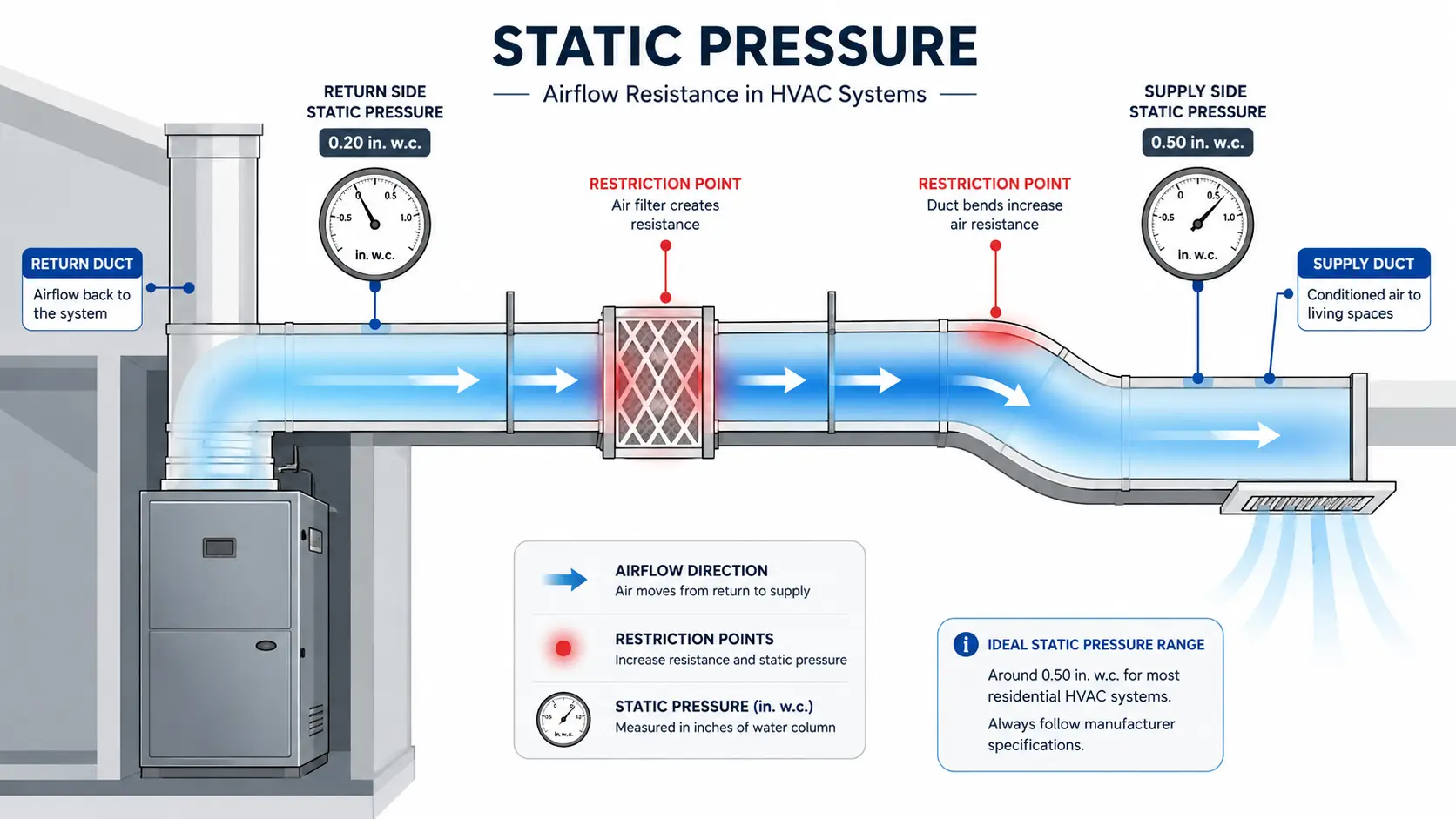
An HVAC blower faces a similar problem. Air must pass through the filter, evaporator coil, supply plenum, ducts, bends, dampers, registers, and return path. Each part can add pressure loss.
Static pressure is measured in inches of water column, written as in. w.c. or IWC. HVAC technicians use a manometer to measure these pressure changes.
Static pressure does not mean that one part is always “bad.” A filter, coil, or duct may work as designed but still create some pressure drop. The concern starts when total resistance becomes too high for the equipment and airflow requirements.
Static Pressure vs. Dynamic or Velocity Pressure
Static pressure and velocity pressure are related, but they are not the same.
- Static pressure is the pressure that acts on the walls of the duct and other surfaces.
- Dynamic pressure, also called velocity pressure, relates to the motion of air. Faster air creates more velocity pressure.
- Total pressure combines static pressure and velocity pressure.
Airflow is usually measured in CFM, which means cubic feet per minute. CFM tells you how much air moves. Air velocity tells you how fast the air moves. Static pressure tells you about pressure within the air system.
This difference matters during testing. A technician cannot look at one pressure reading and assume the system is delivering the correct CFM.
What Does Static Pressure Tell You About an HVAC System?
HVAC static pressure can help reveal problems with airflow and duct design.
For example, a dirty filter may create a larger pressure drop. A crushed flex duct can also add resistance. A return duct that is too small may force the blower to work against more resistance.
ACCA notes that static pressure testing can help verify installed duct performance and compare measured total external static pressure with the equipment’s rated value.
So, static pressure is best viewed as one part of an airflow diagnosis. It does not replace airflow testing, blower data, or a full system check.
What Is External Static Pressure in an HVAC System?
External Static Pressure Explained
External static pressure, or ESP, is the pressure measured outside the air-moving equipment as air enters and leaves the equipment.
For many residential systems, technicians look at the return and supply sides of the equipment. These readings help show how much resistance the external air path places on the blower.
The equipment manufacturer gives a rated maximum external static pressure. That rating is important because different furnaces and air handlers can have different pressure limits.
Supply-Side vs. Return-Side Static Pressure
The return side pulls air toward the blower. It normally has a negative pressure relative to the surrounding room.
The supply side pushes conditioned air into the duct system. It normally has positive pressure.
Both sides can create pressure loss.
For example, imagine a system with:
- Return-side pressure: 0.25 in. w.c.
- Supply-side pressure: 0.35 in. w.c.
When these readings are taken with the correct test setup, their combined value is 0.60 in. w.c.
What Is Total External Static Pressure?
Total external static pressure, or TESP, is the combined external pressure measured across the air-moving equipment.
A technician may use test ports near the equipment to measure the return and supply sides. ACCA describes a TESP test that uses a dual-port manometer, then compares the measured value with the rated TESP on the equipment nameplate.
This is useful because a single supply or return reading does not show the full external pressure picture.
The exact test points matter. Equipment design also matters. That is why a pressure number taken from an unknown location should not be treated as a complete HVAC diagnosis.
What Is the Ideal Static Pressure in HVAC?
Many homeowners hear that 0.5 in. w.c. is the ideal number. That value is common in residential HVAC discussions, but it is not a universal target for every system.
The answer depends on the equipment, blower, required airflow, and manufacturer rating.
Is 0.5 in. w.c. Always Ideal?
No.
A system may have a rated maximum TESP that differs from another system. The manufacturer’s installation manual, data plate, and blower performance data should guide the test.
For example, a 0.70 in. w.c. reading cannot be called “bad” without knowing the equipment rating and operating conditions.
The same rule applies to a 0.40 in. w.c. reading. A lower number is not automatically better. If airflow is wrong or the test was done at the wrong point, the number may not tell the full story.
ACCA’s duct design guidance ties external static pressure to manufacturer blower data, airflow, and duct design.
What Do 0.5, 0.7, and 1.0 in. w.c. Mean?
These numbers describe measured pressure in inches of water column.
They do not, by themselves, tell you whether an HVAC system is healthy.
A technician should compare the reading with:
- Rated external static pressure
- Required CFM
- Blower performance data
- Filter pressure drop
- Coil pressure drop
- Duct pressure loss
- Equipment operating mode
If a system measures 1.0 in. w.c., that may be a serious concern for some equipment. But the proper answer comes from the equipment data, not from a generic chart.
Where Is the Static-Pressure Rating Found?
Look for the equipment:
- Data plate
- Installation manual
- Manufacturer specification sheet
- Blower performance tables
- Rated maximum external static pressure
ACCA also teaches the use of OEM performance data when diagnosing airflow and HVAC performance.
How Is Static Pressure Measured in an HVAC System?
A trained technician uses a pressure tool rather than guessing from airflow at a register.
Tools Used to Measure Static Pressure
Common tools include:
- Digital manometer
- Differential manometer
- Magnehelic gauge
- Static pressure probe
- Pressure tubing
- Test ports or duct taps
A dual-port manometer allows the technician to compare pressure at two test points. ACCA identifies this type of instrument for measuring HVAC static pressure and TESP.
Where Is Static Pressure Measured?
Test locations vary with equipment type and the reason for the test.
A technician may check pressure:
- On the return side
- On the supply side
- Near the air handler
- Near the furnace
- Before or after certain air-side components
The goal is to measure the right pressure at the right location.
How a Static-Pressure Test Works
A typical diagnostic process looks like this:
- Put the HVAC system in the proper operating mode.
- Confirm the correct test points.
- Use suitable test ports and a pressure probe.
- Measure return-side pressure.
- Measure supply-side pressure.
- Determine the TESP.
- Compare the result with manufacturer data.
- Check blower operation and required CFM.
- Test individual pressure drops when needed.
ACCA describes a similar field test process and recommends comparing measured TESP with the equipment’s rated TESP.
This is why one pressure reading rarely gives the full answer.
What Causes High or Low Static Pressure in HVAC Systems?
High static pressure usually means the air path has more resistance than the system should have under the test conditions.
Common Causes of High Static Pressure
Common causes include:
- Dirty air filter
- Restrictive filter media
- High-MERV filter that the system cannot handle well
- Dirty evaporator coil
- Undersized return duct
- Undersized supply duct
- Crushed flex duct
- Excessive duct bends
- Too many restrictive fittings
- Blocked return grille
- Closed dampers
- Restrictive air-side accessories
- Poor duct design
- Poor equipment and duct matching
ENERGY STAR also points to crushed ducts, sharp bends, and other duct defects as sources of added static pressure.
What Can Cause Low Static Pressure?
Low static pressure is not automatically a sign of a healthy HVAC system.
Possible causes include:
- Duct leakage
- Incorrect blower setup
- System configuration problems
- Insufficient airflow
- Poor test setup
- Incorrect test locations
- Other conditions that lower measured system pressure
A low reading needs context. The technician should check airflow, blower operation, duct condition, and equipment data before deciding what it means.
How Duct Size Affects Static Pressure
Duct size has a direct effect on air movement.
A small duct can force air to move faster. Higher air speed can increase friction and pressure loss.
Long ducts also add resistance. Bends, elbows, transitions, dampers, and poor flex duct installation can add more pressure loss.
ACCA Manual D provides recognized guidance for residential duct design. It covers duct sizing, airflow distribution, flexible duct issues, testing, balancing, and air velocity.
How Does Static Pressure Affect HVAC Performance?
Static Pressure and Airflow
A blower has a limited ability to move air against system resistance.
As resistance rises, the blower’s delivered airflow can change. If the system does not deliver the required CFM, heating and cooling performance may suffer.
This is why static pressure should be checked with blower performance data instead of treated as an isolated number.
Static Pressure, Energy Use, and Blower Stress
A blower working against high resistance may need to work harder to move air.
That can affect motor operation and system energy use. The exact effect depends on the blower, controls, operating speed, and system design.
A good diagnosis looks at measured pressure and airflow rather than promising a fixed energy saving.
Static Pressure and Comfort
Airflow problems can show up as comfort problems.
You may notice:
- Weak airflow from vents
- Hot or cold rooms
- Uneven temperatures
- Long run times
- Poor air distribution
- Rooms that struggle to reach the thermostat setting
These signs can have many causes. Static pressure is one test that can help narrow them down.
Static Pressure, Humidity, and Indoor Air Quality
Cooling systems need proper airflow to transfer heat and moisture from indoor air.
If airflow is too low, cooling performance may suffer. Poor air distribution can also leave some rooms less comfortable or more humid.
Airflow also affects filtration. A filter needs the correct airflow path to do its job without creating excessive pressure loss.
Static Pressure and Equipment Life
Excessive resistance can place added demand on the blower and affect system operation.
Poor airflow can also affect coil performance. In cooling mode, inadequate airflow can contribute to coil icing under certain conditions.
In heating mode, airflow problems can affect heat transfer and system operation.
Static pressure testing helps find these problems before a small duct or filter issue becomes a larger service problem.
What Are the Signs of a Static Pressure Problem?
Static pressure problems can look like many other HVAC faults.
Common warning signs include:
- Weak airflow
- Loud blower noise
- Loud return-air noise
- Whistling
- Uneven room temperatures
- Long run times
- Short cycling
- High energy use
- A frozen evaporator coil
- Filters that load with dust very quickly
Symptoms and Possible Causes
| Symptom | Possible airflow-related cause |
| Weak airflow | Restriction, duct issue, or blower setup |
| Loud return noise | Restricted return path |
| Whistling | Restriction, leakage, or high local air speed |
| Uneven temperatures | Air distribution or duct problem |
| Frozen coil | Possible low airflow, among other causes |
| Long run times | Airflow, capacity, or other system issue |
| Short cycling | Many possible causes, including issues unrelated to static pressure |
These symptoms do not prove that static pressure is the problem. A proper test is needed.
When Should You Request a Static-Pressure Test?
Consider testing when you have repeated airflow problems, major duct changes, unexplained comfort issues, excessive blower noise, or a recurring frozen coil.
Testing is also useful during equipment replacement. A new furnace or air handler cannot solve every duct problem.
How Do You Fix and Prevent Static Pressure Problems?
Start with simple checks before changing ductwork.
Check Basic Airflow Restrictions
Replace a dirty filter with the correct size and type. Check return grilles and supply registers for blockage.
Do not install a higher-MERV filter just because it has a better particle rating. A more restrictive filter can increase pressure drop if the system is not designed for it.
Correct Ductwork Problems
A qualified technician may need to:
- Repair crushed flex duct
- Improve restrictive return ductwork
- Correct undersized supply ducts
- Seal major duct leaks
- Correct bad fittings and transitions
- Adjust dampers
- Improve return-air capacity
The right fix depends on the measured pressure loss.
Check Equipment and Blower Operation
The technician should also check:
- Blower speed
- Blower setup
- Coil condition
- Filter pressure drop
- Equipment configuration
- Manufacturer airflow data
ACCA links proper duct design with blower performance and airflow needs.
When Manual D Is Needed
For major duct redesign, Manual D provides a recognized method for residential duct sizing.
It considers items such as:
- Available static pressure
- Component pressure losses
- Total effective length
- Friction rate
- Duct size
- Required airflow
ACCA states that Manual D matches duct-system resistance with blower performance to help deliver the needed airflow.
ACCA Manual D residential duct design guidance
Why You Should Not Fix Static Pressure by Guesswork
A bigger duct is not always the right answer. A lower pressure reading is not always better either. The goal is to create a system where the equipment, blower, ductwork, filter, coil, and airflow work within their design limits. That requires measurement first, then a repair based on the actual source of pressure loss.
Static Pressure in Commercial HVAC Systems
Static pressure also matters in larger HVAC systems.
Static Pressure in VAV Systems
A VAV system, or variable air volume system, changes airflow to different zones.
VAV boxes use dampers and controls to manage airflow. The supply-air pressure must support the required airflow without creating excessive noise or wasted fan energy.
Static Pressure in Large Commercial Buildings
Commercial systems may include:
- Air handlers
- Supply fans
- Return fans
- VFD-controlled fans
- Large supply ducts
- Large return ducts
- Pressure sensors
- Automated fan controls
The pressure target depends on the system design and control strategy.
Specialized Applications
Static pressure also matters in places where air pressure control is critical, such as cleanrooms, hospitals, data centers, and industrial ventilation systems. These systems can have much more complex pressure control needs than a typical home.
Get Professional HVAC Help in Houston
If your home has weak airflow, noisy ducts, uneven temperatures, or repeated coil-freezing problems, static pressure testing can help find the cause.
75 Degree AC can inspect the airflow path, check equipment operation, and identify duct or system issues that may affect performance. If you need HVAC services in Houston, contact 75 Degree AC to schedule an inspection and get a clear diagnosis based on your system’s actual condition.
Don’t guess at a pressure problem. Have the system tested, compare the results with the equipment data, and fix the source of the airflow restriction.
Static Pressure in HVAC FAQs
Does high static pressure reduce airflow?
It can. Higher resistance can change the blower’s operating point and reduce delivered airflow. The actual result depends on the blower and system design.
Can a dirty filter increase static pressure?
Yes. A dirty or restrictive filter can create more pressure drop. That is why filter condition should be checked during airflow diagnosis.
Can high static pressure damage an HVAC system?
Excessive resistance can place added stress on the blower and may contribute to poor system performance. The risk depends on the equipment and operating conditions.
Can I measure static pressure myself?
A manometer can measure pressure, but correct test locations and operating conditions matter. For a useful diagnosis, professional testing is often the better choice.